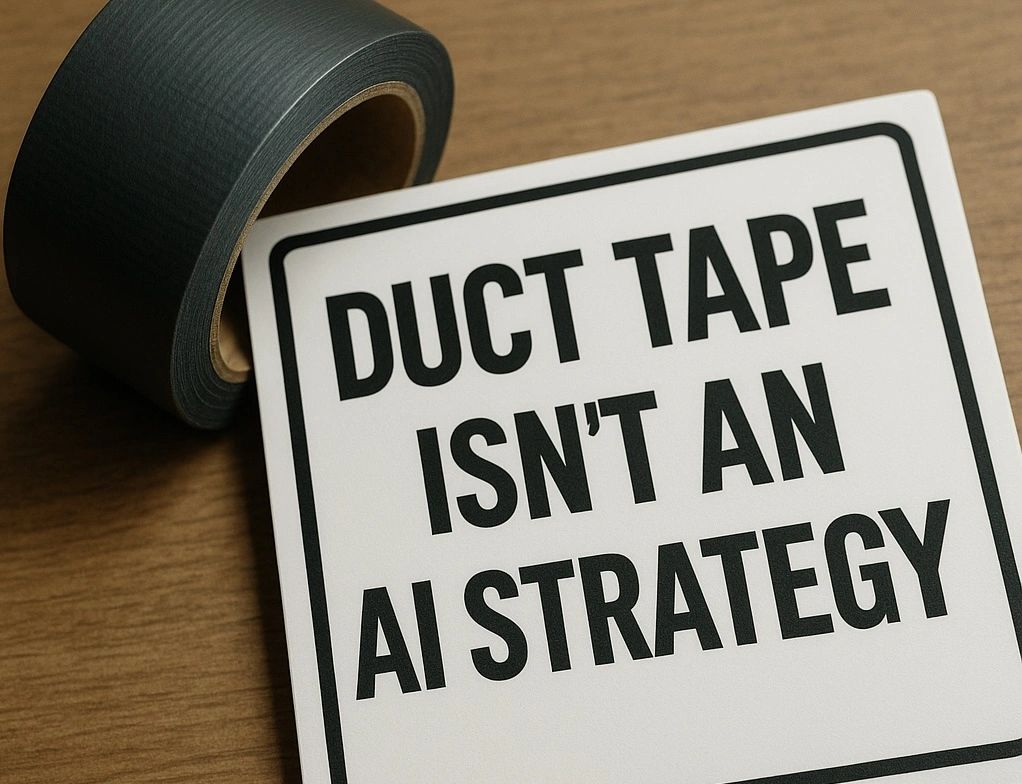
"AI Duct Tape" Isn't An AI Strategy
December 2, 2025
Why bolting AI on isn’t the same as building AI-first (and why your product can tell the difference).
There’s a special moment in every product leader’s life when someone walks into a meeting, usually holding coffee, and sometimes with a tinge of panic, and says, “We need AI in the product… like, yesterday.”
What follows is often a heroic attempt to bolt AI onto an existing system. It's kind of like duct-taping a jet engine to a lawn mower and declaring it “innovation.” It’s exciting, it’s loud, and it will absolutely end in a small fire and an insurance claim.
The truth is simple: AI-Enhanced products add AI.
AI-Native products are built around AI.
And those two approaches lead to wildly different user experiences, technical architectures, and outcomes. One feels like a clever add-on, and the other feels like magic. (I bet you already know which is which.)
Let’s dig into what separates the two, and why the future belongs to the teams who design AI into the product rather than simply bolt it on. Because in more than a few products I’ve seen, the “just add AI” approach ends up feeling a lot like putting lipstick on a pig.
**The Core Difference **
(In plain, sightly sarcastic English)
AI-Enhanced = “Look! We Added an AI Button!”
You take an existing workflow, plug in a model call somewhere, and hope customers get excited enough to ignore the cracks. It’s basically like sprinkling powdered sugar on stale donuts.
AI-Native = “The Product Doesn’t Work Without Intelligence.”
AI is the engine, not the cupholder. It drives the experience, shapes the workflows, and makes the product fundamentally different (and more valuable) than what came before.
To put it bluntly:
AI-Enhanced is a feature.** **AI-Native is a strategy.
**Architectural Differences **
(Or if you prefer: Why Your Existing Monolith Is Crying)
AI-Enhanced Architecture
This approach looks like the diagram equivalent of a sticky note:
- Existing system
- One or two AI endpoints
- A light wrapper
- Some prompt engineering
- A very stressed PM insisting “this is MVP!”
It works, and it’s fine. But it isn’t transformational. You’re essentially translating existing steps into an AI-assisted shortcut.
Example**:** A CRM that adds “Generate an email” to an existing toolbar. Useful? Yes. Revolutionary? Not really.
AI-Native Architecture
AI-native products rethink the flow from the ground up. They use:
- Event-driven architecture
- Fine-tuned models
- RAG pipelines tied directly into the data layer
- Orchestration systems that run tasks and workflows autonomously
- Continuous model monitoring and self-healing systems
The result is a product where intelligence is built into every layer. From data ingestion to workflow outcomes.
Example**:** A CRM that recommends donor actions, writes content, predicts churn, orchestrates next steps, and executes tasks automatically unless the user says otherwise.
One is a tool. The other is a partner.
**Mindset Shifts **
(A.K.A. How teams must evolve)
Transitioning from AI-Enhanced to AI-Native isn’t just an architecture problem. It’s a philosophy problem. Here’s how your thinking must shift.
1. From “What Can AI Automate?” to “What Should AI Own?”
AI-Enhanced teams tend to treat AI like a helpful intern. Great for small tasks, handy for shortcuts, but always needing supervision and a gentle reminder not to break anything. They look for places where AI can shave off a few steps or speed up an existing workflow without fundamentally changing how the product works.
AI-Native teams, on the other hand, treat AI as a core capability with real ownership and defined responsibilities. Instead of asking where AI can assist, they ask where AI should lead, drive outcomes, and manage the heavy lifting so humans can focus on oversight and decision-making. This shift elevates AI from a “nice-to-have” feature to an essential part of how the entire product delivers value.
2. From “Let’s Add AI to Existing Flows” to “Let’s Rebuild the Flow Around Intelligence”
You stop mapping inputs → outputs and start mapping intent → outcomes.
You don’t ask “Where can AI fit?” but “Where does human judgment matter most, and how do we amplify it?”
3. From “Users Will Tell the AI What to Do” to “AI Will Tell Users What They Can Do Next”
In an AI-Enhanced world, the system waits for instructions. Users type a prompt, click a button, or initiate a workflow, and the AI responds like a well-behaved, slightly overqualified assistant. It’s reactive by design, helping only after the human says, “Go.”
AI-Native products flip this dynamic. They continuously interpret context, anticipate needs, and proactively surface recommendations, next steps, and opportunities the user might not have even recognized. Instead of responding to intent, they reveal it.
This shift from reactive to proactive is where the magic happens. It creates delight because the product feels genuinely helpful, stickiness because users return to something that “just gets them,” and differentiation because very few products are capable of delivering intelligence that leads rather than follows.
4. From “Fast Demo” to “Long-Term Reliability”
The AI-Enhanced world worships cool demos.
The AI-Native world worships:
- p95 latency
- hallucination mitigation
- trust scores
- enterprise-grade reasoning
- ethical guardrails
- and the sacred art of “not scaring customers”
5. From “We Added a Feature” to “We Rebuilt the Product’s Brain”
In an AI-Enhanced mindset, teams celebrate adding an intelligent feature, a smart button here, a predictive insight there, treating AI as a layer that sits politely on top of the existing product. It’s useful, but it doesn’t fundamentally alter how the system thinks or behaves.
AI-Native teams take a far more transformative approach. They rebuild the product’s underlying intelligence architecture so that AI becomes the decision engine, the workflow conductor, and the central nervous system of the entire experience. Suddenly, the product isn’t just doing more, it’s understanding more, predicting more, orchestrating more, and compounding value with every interaction.
When AI becomes the brain of the system, the value curve changes exponentially. You unlock capabilities that weren’t possible before, turning the product from a tool that executes tasks into a living, learning system that drives outcomes.
**Organizational Implications **
(The Part Nobody Warns You About)
Going AI-Native transforms not only your product, but your entire org.
1. New Roles Emerge
You start hearing titles like AI Architect, Prompt Engineer (yes, it’s real), Model Ops Lead, AI Quality Engineer, Data Steward, AI Risk Specialist. Before you know it, you’re running a tiny research institute inside your product team.
2. Cross-Functional Teams Must Actually Function
AI-Native demands collaboration between Product, Engineering, Data Science, Security, Legal, Customer Success, Sales.
It feels fun at first, gets messy fast, and eventually transforms into something impressive.
3. Your Roadmap Changes Shape
AI-Enhanced roadmaps look more or less like this:
- Add a model call
- Tune prompts
- Ship
While AI-Native roadmaps look something like this:
- Build a data acquisition pipeline
- Fine-tune a domain-specific model
- Establish new trust metrics
- Ship a multi-agent workflow engine
- Re-architect user roles
- Communicate new mental models
Yes, it’s more complex, but the payoff is also exponentially higher for your customers and your organization. The added sophistication unlocks entirely new workflows, deeper automation, and smarter decision support that simply aren’t possible in a traditional product model. In the end, that complexity becomes a competitive advantage rather than a burden.
4. QA Looks Like a Crime Scene Investigation
AI-Native testing involves far more than the usual unit tests and regression suites. It’s an entire investigative discipline. You need red teaming to probe for vulnerabilities, harmful outputs, and creative ways the system might misbehave when nudged by a determined (or mischievous) user. You add simulation, running thousands of synthetic interactions to see how the AI responds under pressure, in edge cases, and in conditions no human tester would have the patience to reproduce manually.
Then come hallucination stress tests, where you intentionally push the model toward ambiguity, incomplete data, or tricky prompts to see if it confidently invents answers out of thin air. Retrieval quality checks ensure your RAG pipeline is actually grounding the AI in the right information instead of pulling random tidbits from the void. And finally, confidence alignment scoring helps you verify that the AI expresses the right level of certainty. No timid correctness and no bold, swaggering wrongness.
Put it all together, and the testing process starts to feel less like software QA and more like CSI: Product Management. Complete with dramatic reveals, suspicious behavior analysis, and the occasional “YEAHHHH!” as you catch the model in the act.
5. Customer Experience Becomes Education + Enablement
Your users now need guidance on:
- What AI can do
- What it shouldn’t do
- When to trust
- When to override
- How to collaborate with intelligence
An AI-Native product transforms the customer experience from manual execution to guided, intelligence-driven workflows. Instead of forcing users to click through endless steps, the system anticipates what they’re trying to accomplish and handles much of the work automatically. It proactively surfaces insights, recommends next actions, and orchestrates tasks behind the scenes. The result is a product that feels less like a tool and more like a capable partner that understands context and actively supports the user’s goals.
Why AI-Native Wins Long Term
AI-Enhanced products give you quick wins while AI-Native products give you durable competitive advantage.
AI-Native unlocks:
- More automation
- Higher differentiation
- Stickier workflows
- Better data feedback loops
- Higher margins
- Faster expansion opportunities
- A foundation for agentic workflows (the next big wave)
And perhaps most importantly: AI-Native products can learn continuously. They improve as they absorb more data, encounter new scenarios, and refine their understanding of user intent. They evolve. Sometimes subtly, sometimes dramatically. Becoming smarter, faster, and more capable without requiring a complete overhaul every quarter.
In contrast, AI-Enhanced products improve only incrementally. They get occasional upgrades, a fresh prompt here, a model swap there, maybe even a nice UI polish. But at their core, they remain static systems with intelligence bolted on rather than intelligence built in. They don’t grow; they just get patched.
It’s the difference between raising a child versus buying a Roomba. One learns, adapts, and surprises you with new capabilities over time. The other just bumps into the same coffee table forever, no matter how many firmware updates you lovingly install. AI-Native products develop; AI-Enhanced products repeat.
Closing Thought
AI-Enhanced is where most teams start, and there’s nothing wrong with that. It’s fast, safe, and great for discovery. But the products that redefine categories, disrupt incumbents, and get customers to say “how did I ever live without this?” are the ones that go AI-Native.
Because when intelligence becomes the foundation and not the frosting, you stop building tools and start building transformation.
Wishing everyone all the best
Mike
Previous
AI Quality: Preventing Confident Lies
Next
Your AI Pilot Shouldn’t Require a Fire Extinguisher
Continue exploring

July 21, 2026
When a Suite Becomes a Platform
Spend enough time in enterprise software and you’ll eventually notice that certain words begin to lose their meaning. "Innovation" is one of them. "Transformation" is another. Lately, I think "platform" belongs on that l...

August 17, 2026
When Architecture Becomes Experience
One of the more interesting things I’ve noticed over the years is that software companies and customers often define the word platform very differently.

May 21, 2026
We Fixed Development. Oops.
The first wave of AI disruption inside most companies has been focused on Product and Engineering. That makes sense. The ability to generate working code in minutes instead of weeks is flashy. It gets attention. It creat...