
One of the more interesting conversations I've been having lately starts with a deceptively simple question. Should AI be visible?
My answer, after a lot of back and forth, AI should be invisible while it works, and visible in the value it creates. Getting that balance right, I think, is one of the more underrated jobs in product management right now.
It's tempting to treat this as a UX question. Does every AI capability need its own button? Should customers always know when AI is involved? Should we slap an "AI" badge on every recommendation, summary, or prediction so people know what's happening under the hood? But the more I sit with it, the more I think the real question isn't whether AI should be visible. It's when, and why."
Like most product decisions, there's no universal answer. Sometimes making AI highly visible is exactly right. Other times, drawing attention to it actually makes the product worse.
Take a customer who deliberately wants AI's help. Drafting an email, brainstorming, summarizing a meeting, asking questions about their data. Here, the AI is the experience. It deserves to be front and center, because the customer chose to engage with it. They want to understand what it can do, they want to trust it, and if it's recommending an action that needs their approval, they need to know exactly where that recommendation came from.
Now picture something different. You're reviewing a project portfolio, and the system quietly notices that one engagement is likely to blow its budget, based on hundreds of signals that would be very difficult to correlate in real time. Or you're in a CRM, and it surfaces customers who are quietly drifting away before anyone else notices. In moments like these, I don't want someone to have to stop, open a chatbot, ask it to analyze the situation, copy the answer, and go back to work. The workflow itself should just get better.
That's the real opportunity, I think. AI doesn't need to become another destination in the product. Often its biggest value comes from quietly removing friction and improving decisions while people stay focused on the work in front of them.
So "visible vs. invisible" isn't really the debate. The real job for product teams is deciding, intentionally, what role AI is playing in each moment. Sometimes it's the product. Sometimes it's just what makes the product better.
Solving that design problem, though, creates a different one.
Something I've learned over the years is that customers don't always connect better outcomes with whatever created them. The more seamlessly a capability blends into everyday work, the easier it is to forget it's even there. I've watched this happen with analytics, workflow automation, reporting, you name it. A feature quietly saves people hours a week, or nudges revenue up, or trims cost out of a process, until it just becomes 'how the software works.' Nobody thinks about it anymore."
Then renewal season shows up. Someone looks at the invoice and asks whether the org is actually getting enough value to justify it. Nothing has changed. The feature is saving the same amount of time, driving the same outcomes, but the customer has stopped connecting those outcomes to the thing they originally paid for.
AI runs into this same problem, maybe more acutely. If customers are paying a premium for it, they shouldn't have to wonder if it's actually making a difference. I don't mean interrupting them every fifteen minutes to announce that AI just saved them thirty-seven seconds. Software that keeps patting itself on the back gets exhausting fast. I mean being intentional about helping people see the value being created.
Sometimes that's at the moment of execution: a recommendation explains why it was surfaced, or what signals led to it. Other times it's better to let the workflow run uninterrupted and show the impact later, in a dashboard, a weekly summary, or an executive report that rolls up what AI helped accomplish.
The point is, customers shouldn't have to think about AI every time it helps them. But they also shouldn't have to guess why they're paying for it.
That distinction matters even more for companies that package AI as a separate, premium layer on top of their products, a choice some organizations are making deliberately and others are avoiding just as deliberately, betting that AI should simply be table stakes. Whichever path a company chooses, the PM's job doesn't change. The PM needs to make sure that customers can actually recognize the value being created over time.
Notice I said recognize the value, not the technology. Those aren't the same thing. Most customers don't care which model produced the recommendation, how many prompts ran, or what retrieval approach was used behind the scenes. They care that projects finish on time, customers stay engaged, forecasts get sharper, revenue goes up, and manual work disappears. Those are the outcomes they're actually paying for. AI is just one of the ways we deliver them.
Which, ironically, is exactly why product management matters more now, not less. It's easy to get swept up in the technology. A new model, a new benchmark, a new framework drops every week, and it's genuinely exciting. But customers don't measure our success by how sophisticated our implementation is. They measure it by whether their work got easier. Were there better decisions made, real time saved, mistakes avoided, results they couldn't get before. Those are product questions, not technology questions.
I've said before that I think the future belongs to product builders, and I still believe that. But being a product builder was never really about learning the newest AI tools or finding clever new ways to use them. It's about knowing when the technology should step into the spotlight, when it should fade into the background, and making sure customers never lose sight of the value showing up either way.
Invisible while it works. Visible in what it delivers.
That's not just good AI design. It's good product management.
Wishing you all the best, Mike
Continue exploring

August 17, 2026
When Architecture Becomes Experience
One of the more interesting things I’ve noticed over the years is that software companies and customers often define the word platform very differently.
July 21, 2026
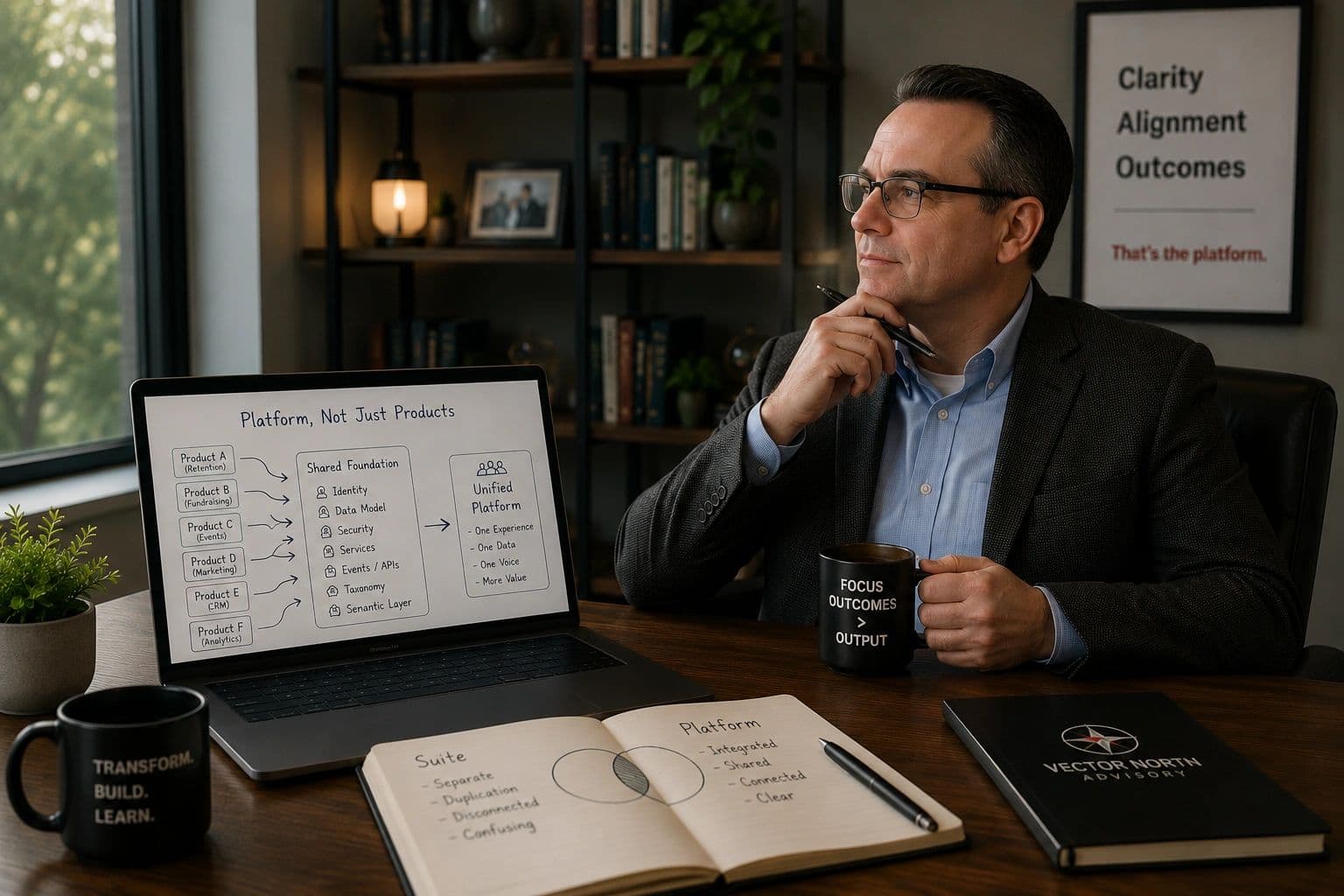
When a Suite Becomes a Platform
Spend enough time in enterprise software and you’ll eventually notice that certain words begin to lose their meaning. "Innovation" is one of them. "Transformation" is another. Lately, I think "platform" belongs on that l...

June 29, 2026
The Skills AI Couldn’t Replace
My laptop has become a retirement community for software projects. (Shady AI-cres...feel free to insert a groan.)