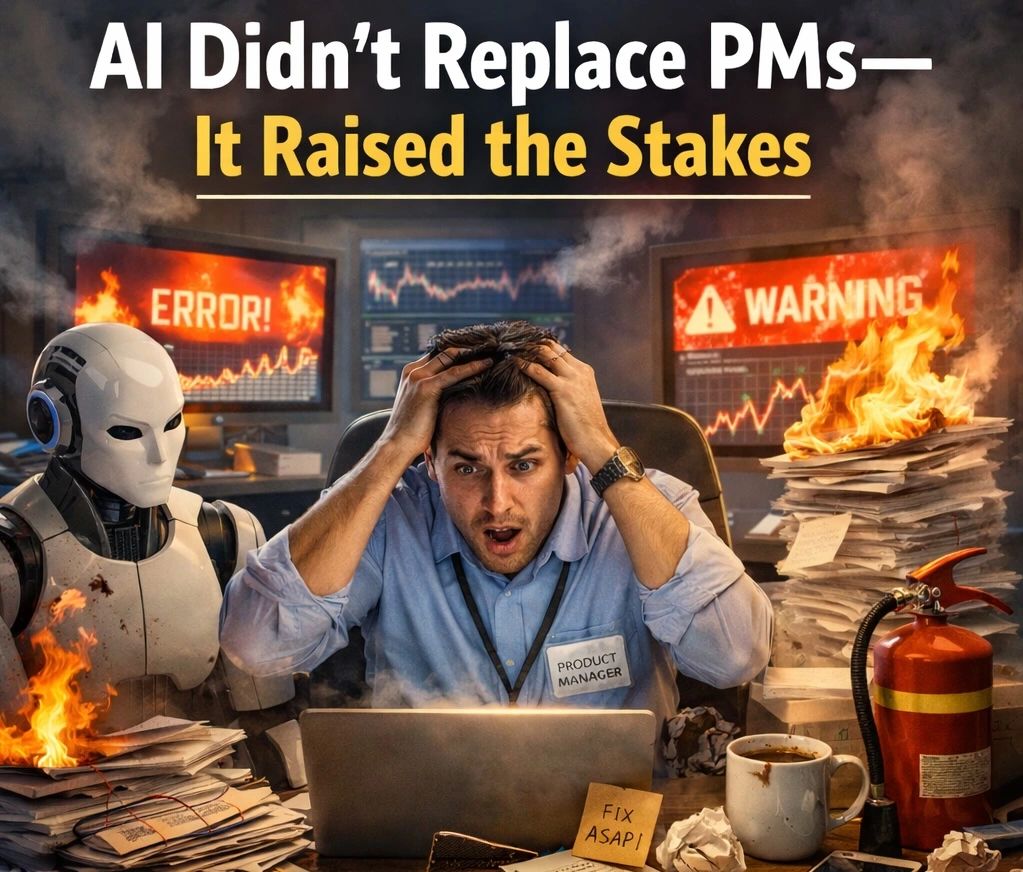
There was a time when being a Product Manager meant mastering the art of roadmaps, stakeholder alignment, and saying “no” with just enough warmth to avoid being disinvited from meetings. You translated customer needs into requirements, shepherded features to launch, and felt a deep sense of accomplishment when something shipped more or less on time.
Then AI showed up. Not loudly at first. Just a few tools, a couple of demos, maybe a slide or two in the board deck. And suddenly, the PM role didn’t disappear… but it definitely changed its posture.
AI doesn’t eliminate product management. It rearranges it.
The biggest shift is that PMs are no longer just responsible for defining what to build; they’re increasingly responsible for deciding how much intelligence the product should have, where it should act on its own, and when it should politely ask a human first. That’s a very different kind of judgment call. You’re no longer managing features so much as managing autonomy. And autonomy, as it turns out, is a little harder to estimate than story points.
In the pre-AI world, good PMs spent a lot of time decomposing problems into neat, deterministic steps. AI does not care about your neat steps. It thrives in ambiguity, pattern recognition, and fuzzy intent. This forces PMs to stop obsessing over perfect flows and start thinking in terms of outcomes, confidence thresholds, and acceptable failure modes. You don’t just ask “Does this work?” anymore. You ask “What happens when it’s wrong, and how wrong is too wrong?”
This shift alone changes the skill set. The modern PM needs to understand models well enough to ask smart questions without pretending to be a data scientist. You don’t need to fine-tune transformers, but you do need to know the difference between training data and production data, why hallucinations happen, and why latency suddenly matters more than feature parity. The PM career path bends away from feature factory management and toward systems thinking, where behavior matters as much as capability.
AI also quietly moves PMs closer to the center of ethical and trust decisions. When software makes deterministic mistakes, they’re usually obvious and reversible. When AI makes mistakes, they can be confident, persuasive, and emotionally unsettling. That means PMs become stewards of tone, transparency, and restraint. You’re not just deciding what the product can do. You’re deciding what it shouldn’t do, even if it technically could. Congratulations, you’re now part product leader, part risk manager, and part adult supervision.
Another major change is how PMs spend their time. AI collapses a lot of the work that used to fill calendars. Competitive analysis, early PRDs, research synthesis, and even basic UX drafts can be accelerated dramatically. This doesn’t make PMs redundant. It makes busywork optional. The career implication is subtle but important: PMs who cling to task execution as their primary value will feel increasingly replaceable, while PMs who lean into decision-making, prioritization, and narrative will feel more valuable than ever.
This is where the career path starts to split. One path leads to PMs who use AI as a productivity hack and keep doing the same job, just faster. The other leads to PMs who treat AI as a strategic multiplier and reshape how products, teams, and organizations operate. The second group stops being measured by outputs and starts being measured by judgment quality. Not how many tickets you shipped, but how well you chose where intelligence belonged.
AI also changes how PMs interact with engineering and design. Instead of debating pixel-perfect flows, conversations shift toward guardrails, feedback loops, and failure recovery. Design becomes less about screens and more about confidence signaling. Engineering discussions move from “Can we build this?” to “How do we monitor, constrain, and evolve this safely?” PMs who thrive here are the ones who can translate uncertainty into direction without pretending certainty exists.
Perhaps the most uncomfortable change is that AI exposes shallow product thinking very quickly. It’s easy to hide behind process in traditional product development. It’s much harder to do that when the system behaves unexpectedly and users immediately feel it. AI forces PMs to confront reality faster. If you don’t deeply understand the customer problem, the AI will amplify that misunderstanding at scale. That’s not a great look.
The upside is that AI also creates new opportunities for PMs to grow into more influential roles. As products become more intelligent, PMs increasingly operate at the intersection of data, UX, business strategy, and organizational trust. This pulls the role upward. Strong AI-era PMs don’t just manage backlogs, they help define how intelligence becomes a competitive advantage. They influence pricing, positioning, go-to-market strategy, and even company values.
Over time, this reshapes the PM career ladder. The path forward isn’t just Senior PM to Group PM to Director. It’s evolving toward roles like AI Product Lead, Intelligence Strategy Director, or Head of Product Intelligence. These aren’t gimmicky titles. They reflect a real shift in responsibility: owning not just what the product does, but how it thinks.
The irony is that as AI becomes more capable, the PM role becomes more human. Judgment, empathy, ethics, and clarity matter more, not less. The PM who succeeds in this era isn’t the one who knows every framework, but the one who can say, “This is good enough,” “This is too risky,” or “This is powerful, but not yet.” Those are not things AI can decide for you, at least not responsibly.
So no, AI isn’t ending the PM career path. It’s raising the bar. It’s turning the role from feature coordinator into intelligence architect. And while that might feel unsettling, it’s also the most interesting evolution product management has seen in decades.
If you were looking for a safe, predictable job, this may not be your favorite chapter. But if you were hoping the PM role would finally reward judgment over Jira hygiene, AI just opened that door wide. Embrace it.
Wishing you all the best
Mike
Previous
Your AI Pilot Shouldn’t Require a Fire Extinguisher
Next
AI Explained for the Rest of the Company
Continue exploring
August 17, 2026
When Architecture Becomes Experience
One of the more interesting things I’ve noticed over the years is that software companies and customers often define the word platform very differently.
July 21, 2026
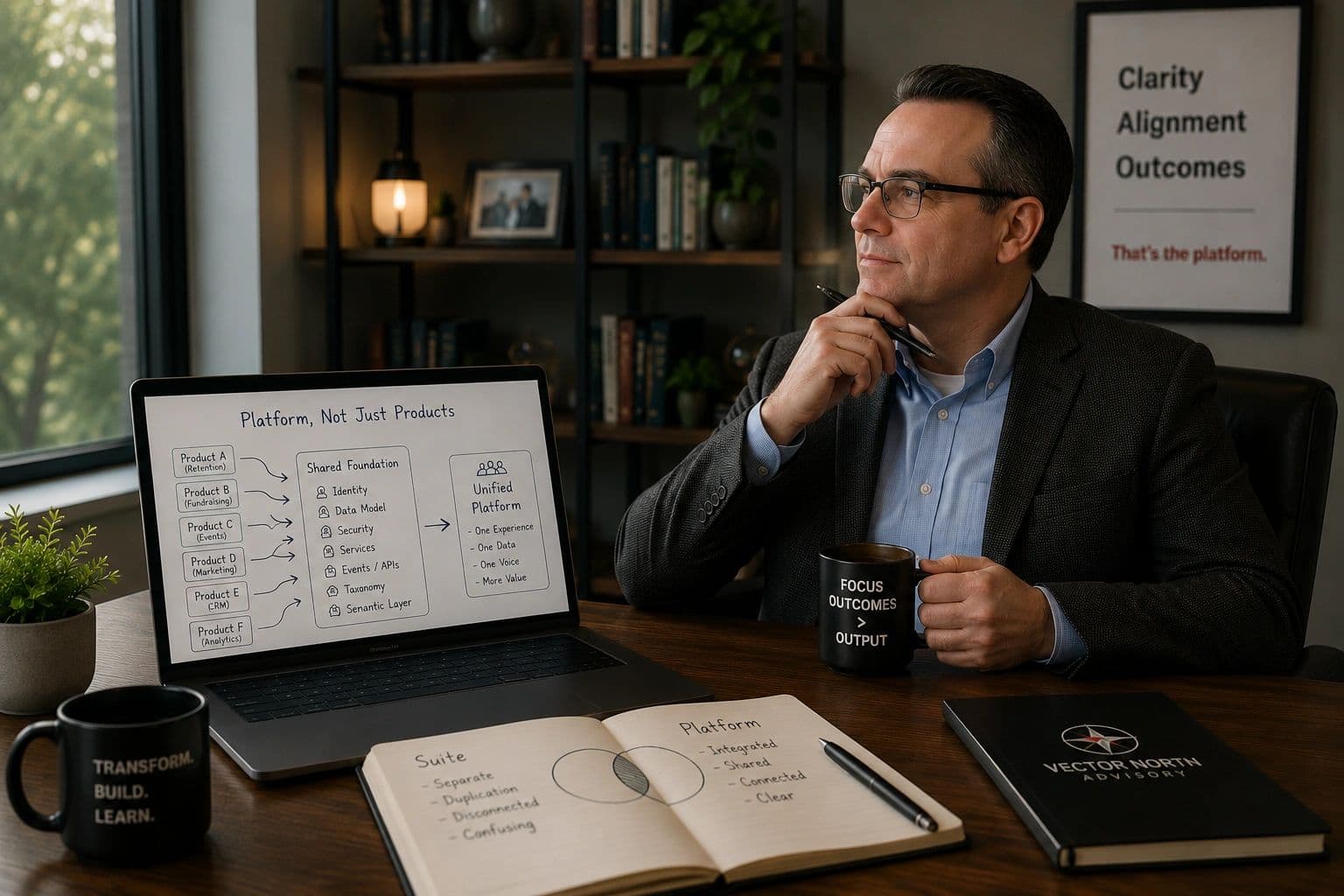
When a Suite Becomes a Platform
Spend enough time in enterprise software and you’ll eventually notice that certain words begin to lose their meaning. "Innovation" is one of them. "Transformation" is another. Lately, I think "platform" belongs on that l...
July 6, 2026
Invisible During the Work. Visible in the Value.
One of the more interesting conversations I've been having lately starts with a deceptively simple question. Should AI be visible?