I’ve Seen This Before. Just Not This Fast.
May 4, 2026
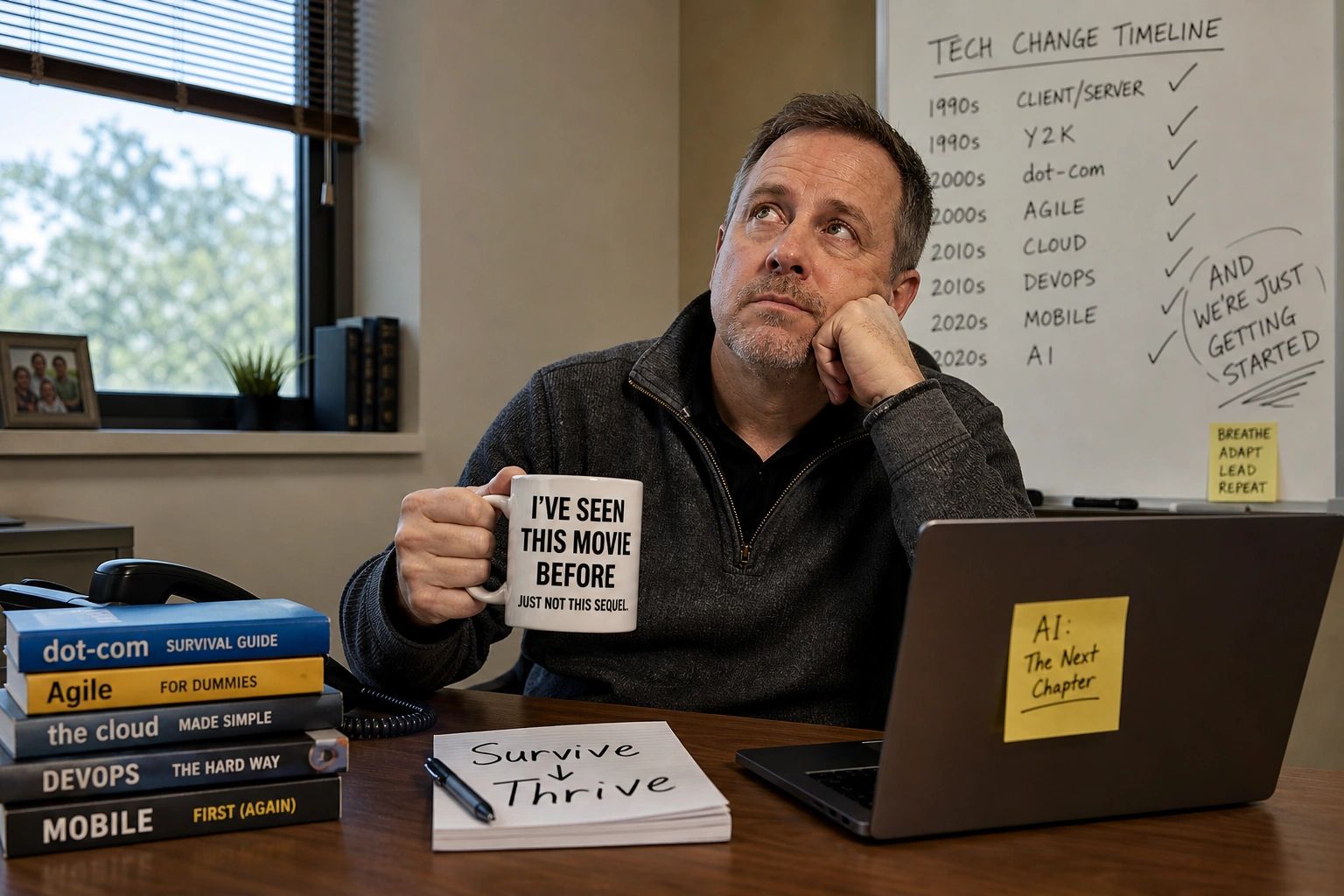
I’ve been around the block a few times. (Yeah, yeah, I know...)
Long enough to remember when the “big shift” was moving from green screens to graphical user interfaces. (Ah, those were the simple days...) The first time someone handed me a mouse, it felt less like progress and more like a trust exercise. There were people who had mastered one way of working, built real expertise around it, and suddenly found themselves staring at something that made them feel like beginners again. There was excitement, but there was also a quiet question sitting just below the surface: am I going to be able to keep up with this?
Then came the internet. That one felt much bigger at the time. Entire industries were trying to figure out whether it was hype or the future. I remember conversations where people debated whether it even mattered yet, while others were convinced it was going to change everything. There was curiosity, skepticism, and a fair amount of “let’s wait and see.” And again, underneath it all, people were trying to figure out what it meant for them. (I still hear the squeal of the modem, and someone picking up the phone and interrupting my 3 hour 4MB download when there was only 15 minutes remaining.)
Not long after that, web applications took off, followed by SaaS. That shift forced teams to rethink how software was built, delivered, and supported. The move from shipping once a year to delivering continuously wasn’t just a technical evolution, it was a cultural one. Some people loved it. Others missed the predictability of the old world. A few just wanted to know when things were going to slow down again. (Spoiler: they didn’t.)
Then Agile showed up. Then DevOps. Then cloud. Then mobile. At some point it stopped feeling like waves and started feeling like a conveyor belt set to “slightly faster than comfortable.”
Every one of those shifts had something in common. There was always a group that leaned in early, a group that hung back, and a group that quietly wondered if they had just become obsolete overnight. Not because they lacked talent, but because the rules of the game kept changing.
And every time, leadership mattered.
Not because leaders had everything figured out, but because people were looking for signals. Is this real? How seriously should I take it? Am I expected to change? What happens if I don’t? Am I about to have to explain to my family what “re-skilling” means?
Those questions weren’t always asked out loud, but they were always there.
What’s happening now feels familiar, but also different in a way that’s hard to ignore.
AI isn’t arriving in waves. It’s showing up everywhere, all at once. It’s not confined to one team or one function. It’s in product, engineering, marketing, support, finance. Basically anywhere someone has ever said, “there has to be a faster way to do this.” And unlike some of the earlier shifts, there isn’t much of a grace period. The expectation to engage is immediate, even if understanding isn’t.
That changes how it feels for people.
In earlier transitions, you could watch from the sidelines for a bit. You could experiment at the edges before it became central to your role. There was time to build confidence before the spotlight found you. Today, that buffer is much smaller. People are being asked to incorporate new ways of working while they’re still trying to figure out what those ways actually are.
If you spend time talking with your team right now, real conversations, not just status updates, you can hear it. It shows up in the questions. How should I be using this? What does this mean for my role? Am I doing this the right way? Am I already behind? And sitting underneath all of that is a quieter question that rarely gets said directly: where do I fit in this?
That’s the part of this shift that feels most familiar, and also the part that feels most different.
The familiarity is the human reaction. We’ve seen this movie before. Curiosity, excitement, hesitation, a little bit of imposter syndrome creeping in at the edges. That hasn’t changed in decades.
What’s different is the pace at which people are being asked to work through it.
As leaders, it’s easy to focus on the upside. We see the opportunity. The acceleration. The ability to move faster, test more ideas, and deliver more value. That perspective matters. It’s part of the job. But there’s another part of the job that matters just as much right now, and it has very little to do with technology.
It’s helping people navigate what this change means for them.
And that requires being much more intentional about how you show up as a leader.
It starts with something simple that is surprisingly easy to overlook: acknowledge the reality. Not the hype, not the headlines, but the actual experience your team is having. Say out loud that this is a big shift. That it’s okay if it feels uncomfortable. That nobody has it fully figured out yet, including you. That alone can lower the temperature in the room more than any strategy presentation ever will.
From there, clarity matters more than urgency. “We need to use AI” isn’t a strategy. It’s a slogan. People need to understand what that actually means in the context of their role. Where should they start? What problems should they be trying to solve? What does “good” look like? If you don’t provide that clarity, people will either freeze or head off in completely different directions.
Modeling behavior is just as important. If you want your team to adopt new ways of working, they need to see you doing it. Talk about how you’re using these tools. Share what worked, what didn’t, and what you’re still figuring out. There’s something powerful about a leader saying, “I tried this yesterday and it didn’t go the way I expected.” It gives everyone else permission to experiment without feeling like they’re being graded in real time.
Creating safe space to learn is another critical piece. In fast-moving environments, there’s a tendency to prioritize output over everything else. But if people don’t feel safe trying new approaches, they’ll default to what they already know. That slows adoption more than anything. Give people time to explore. Encourage them to share what they’re learning. Celebrate progress, not just results. If the only thing that gets recognized is polished output, learning will happen in the shadows, if it happens at all.
You also have to make it real. Abstract conversations about “the future” don’t help someone who’s trying to figure out how to do their job better tomorrow morning. Focus on practical use cases. Where can this save time? Where can it improve quality? Where can it eliminate work nobody enjoys doing anyway? When people see tangible benefits, adoption becomes much more natural.
At the same time, keep an eye on pace. Just because you can move faster doesn’t mean everyone should be expected to move at the same speed immediately. There’s a difference between momentum and overwhelm. Good leaders know how to push forward without creating a sense that people are constantly behind.
And perhaps most importantly, keep the conversation open. Don’t assume silence means comfort. It often means the opposite. Ask people how they’re feeling about the change, not just how they’re performing. Create space for honest dialogue. You don’t need to have all the answers, but you do need to be willing to listen.
There’s also a reality we can’t ignore. Change at this pace isn’t easy, and it doesn’t look the same for everyone. As much as we invest in helping people learn and adapt, these transitions can be challenging. They require new ways of thinking, new habits, and in some cases, a redefinition of how people see their own role. That’s not a small thing. It’s personal. It takes time, and it requires patience from both sides.
As a leader, that’s the part that stays with you. Not just what gets built, but how people experience the process of building it. The conversations you have. The support you provide. The environment you create.
Because long after this wave of change becomes the new normal, and it will believe me, the way people felt during it will stick.
Looking back, every major shift eventually settles. What once felt uncertain becomes expected. What once felt difficult becomes routine. There will come a day when all of this feels obvious, and someone will be explaining the next big shift while everyone else nods along like they’ve seen it before.
But right now, we’re in the middle of it.
The tools will keep evolving. The pace isn’t going to slow down. But the constant in all of this is people. Their willingness to learn, their ability to adapt, and the support they receive along the way.
Leadership, especially now, is about recognizing that.
It’s about understanding that behind every shift in technology is a group of people trying to find their footing, occasionally Googling things they feel like they should already know, and wondering if everyone else has it more figured out than they do.
Spoiler: they don’t. (and anyone that claims they do is full of s**t)
And if you can help your team move forward with a little more clarity, a little more confidence, and maybe even a little less anxiety, you’re probably doing exactly what a leader is supposed to do right now.
Wishing you all the best
Mike
Continue exploring
August 17, 2026
When Architecture Becomes Experience
One of the more interesting things I’ve noticed over the years is that software companies and customers often define the word platform very differently.
July 21, 2026
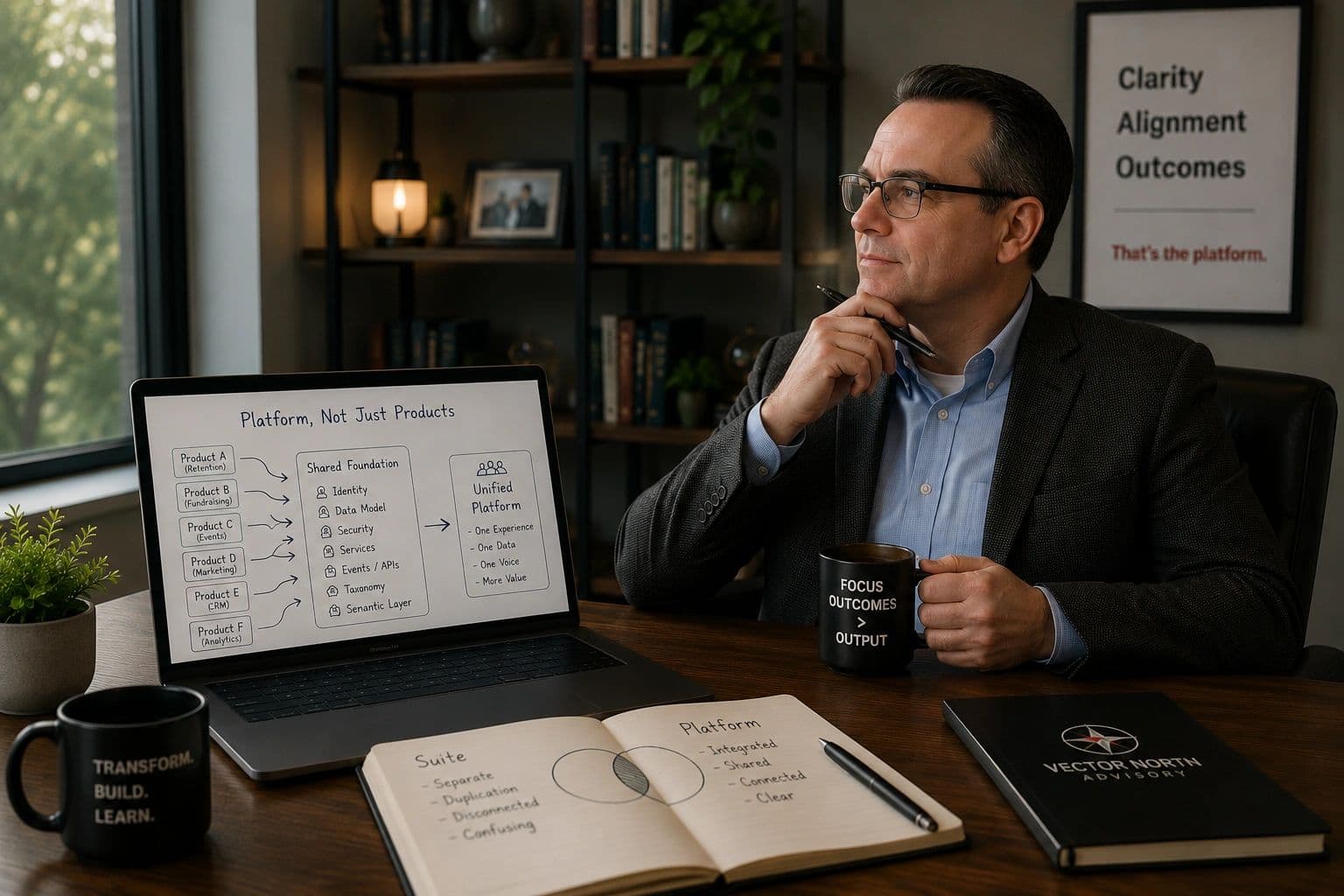
When a Suite Becomes a Platform
Spend enough time in enterprise software and you’ll eventually notice that certain words begin to lose their meaning. "Innovation" is one of them. "Transformation" is another. Lately, I think "platform" belongs on that l...

May 21, 2026
We Fixed Development. Oops.
The first wave of AI disruption inside most companies has been focused on Product and Engineering. That makes sense. The ability to generate working code in minutes instead of weeks is flashy. It gets attention. It creat...