
A lot of people are worried that AI is going to replace workers. That makes for dramatic headlines, panel discussions, and the kind of LinkedIn posts written entirely in capital letters. But I think the bigger story is more subtle than that.
AI is not simply replacing jobs. It is exposing work habits that were already becoming outdated.
For years, many organizations operated on a model that rewarded responsiveness over initiative. Show up. Attend the meetings. Wait for direction. Take the assigned task. Complete the task. Move to the next task. Repeat until retirement, or at least until lunch.
To be fair, that model made sense in a slower-moving world. Information traveled more slowly. Decisions were concentrated at the top. Building anything meaningful often required specialized teams, longer timelines, and layers of handoffs. If you wanted a report, someone had to build it. If you wanted a prototype, you needed budget, design resources, engineering capacity, and patience bordering on sainthood. But that world is fading quickly.
Today, one motivated person with the right mindset and a few AI tools can do things that previously required a small team and several weeks of calendar time. They can analyze data, create first drafts, summarize customer feedback, build working prototypes, automate repetitive tasks, and uncover insights buried inside systems no one has looked at in years.
That changes the value equation inside organizations.
The most dangerous employee in 2026 is not the person using AI. It is the person still waiting to be told what to do.
That may sound harsh, but I do not mean it cruelly. I mean it realistically.
If your entire value proposition is execution of clearly assigned work, you are competing with software, automation, and increasingly capable teammates who know how to amplify themselves. If you need someone else to identify every problem, prioritize every opportunity, and define every next step, you are becoming dependent in a market that increasingly rewards leverage.
The employees who will thrive are not necessarily the loudest, youngest, most technical, or most online. They will be the ones who consistently create motion.
They notice friction and remove it. They see a recurring problem and automate it. They ask better questions. They bring forward options instead of only surfacing obstacles. They learn new tools before being mandated to. They shorten the distance between idea and outcome. In many companies, initiative used to be a nice-to-have trait. It is rapidly becoming table stakes.
This shift is especially visible in product, operations, marketing, customer success, and leadership roles, but it is not limited to those functions. Every team has opportunities hidden in plain sight. Processes that take too long. Reports no one trusts. Manual tasks everyone hates. Customer pain points no one owns. Meetings that exist largely because no one has fixed the root cause they were created to discuss. The old approach is to tolerate these things and work around them. The modern approach is to improve them.
AI matters here because it lowers the cost of action. That is the real disruption. It is easier than ever to test an idea, draft a solution, model a scenario, build a tool, or create a first version of something useful. When the cost of trying drops, the value of initiative rises. You no longer need perfect conditions to start. You need curiosity and a willingness to learn in public.
That does not mean every employee now needs to become a coder, prompt engineer, or startup founder disguised as an analyst. It means ownership matters more than ever. The people who say, “I noticed this and took a first pass,” will consistently outperform the people who say, “No one told me.”
Leaders should pay attention to this too.
Many organizations unintentionally train passivity. They over-control decisions, punish imperfect attempts, reward activity over outcomes, and create approval processes that make initiative feel irrational. Then they wonder why no one acts like an owner. You cannot demand entrepreneurial behavior inside bureaucratic systems and expect magic.
If you want stronger teams, reward people who create clarity, simplify work, solve problems early, and responsibly use new tools to move faster. Celebrate thoughtful experimentation. Make room for people who improve the machine, not just operate it.
And if you are an employee wondering what this means for you, the answer is actually encouraging.
You do not need to know everything. No one does right now. This is still early. Everyone is learning. Even the people posting confident predictions with dramatic profile photos are making some of it up as they go.
What matters is momentum.
Pick one painful process and improve it. Learn one tool that saves you time. Use AI to strengthen your thinking, not replace it. Bring your manager solutions, not just status updates. Become known as someone who makes things better when you touch them. That reputation compounds faster than credentials.
I have spent enough years in business to know that every era creates new signals of value. There was a time when being organized was a superpower. Then being data-driven became the differentiator. Then cross-functional collaboration rose in importance. Now we are entering an era where adaptability, initiative, and intelligent leverage are separating people quickly. Busy is no longer impressive. Everyone is busy. Useful wins.
So yes, AI will change jobs. It already is. But the bigger impact may be that it shines an uncomfortable light on who is creating value and who is waiting nearby for instructions.
If that feels blunt, good. Blunt can be useful.
Because the good news is this is fixable. Initiative is learnable. Curiosity is available to everyone. Ownership costs nothing to begin. And if your current career strategy is quietly sitting in the corner until someone assigns you something, 2026 may be a very educational year.
Wishing you all the best
Mike
Previous
The T-Shirt Still Fits, But the Playbook Doesn’t
Next
I’ve Seen This Before. Just Not This Fast.
Continue exploring

August 17, 2026
When Architecture Becomes Experience
One of the more interesting things I’ve noticed over the years is that software companies and customers often define the word platform very differently.
July 21, 2026
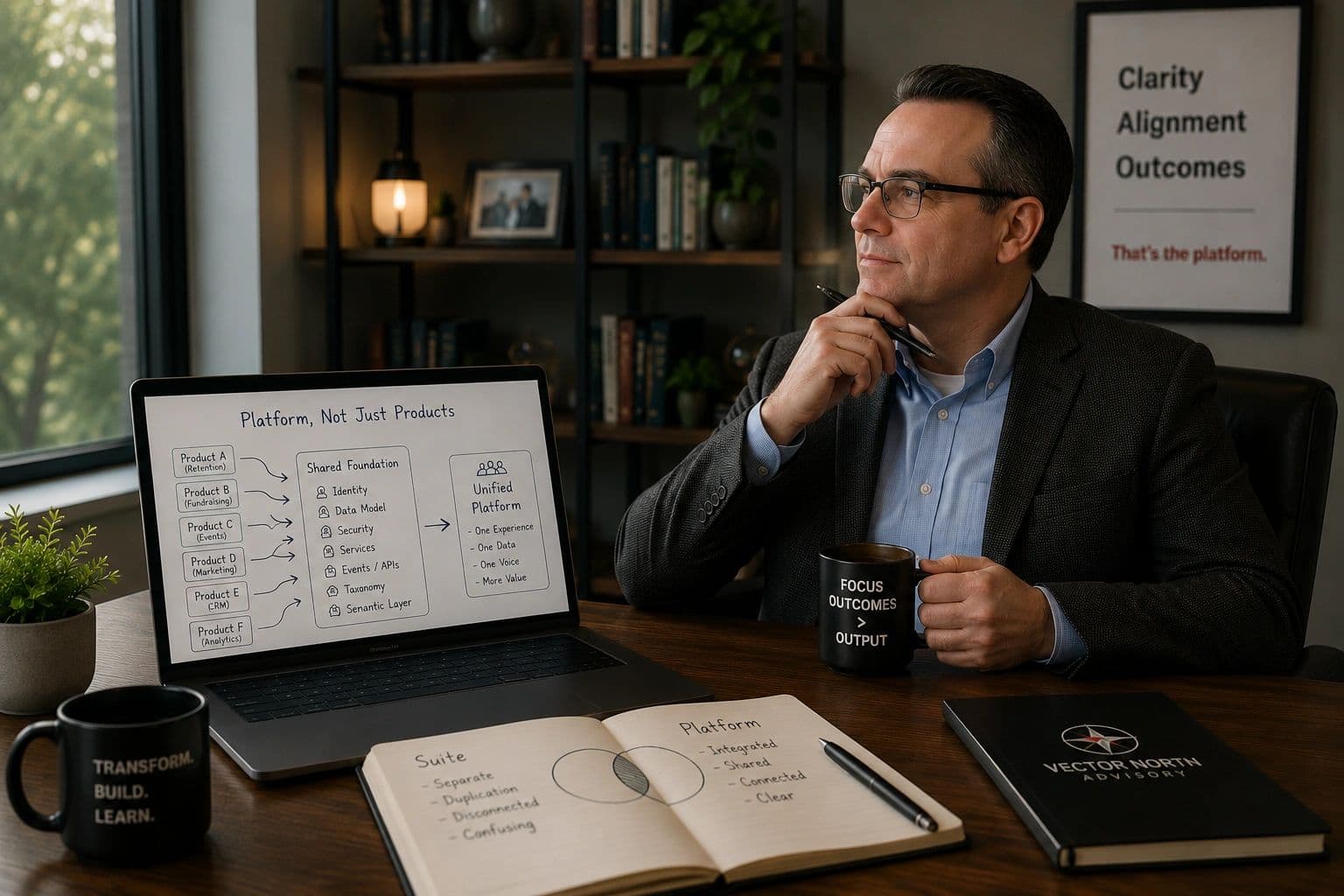
When a Suite Becomes a Platform
Spend enough time in enterprise software and you’ll eventually notice that certain words begin to lose their meaning. "Innovation" is one of them. "Transformation" is another. Lately, I think "platform" belongs on that l...

July 6, 2026
Invisible During the Work. Visible in the Value.
One of the more interesting conversations I've been having lately starts with a deceptively simple question. Should AI be visible?