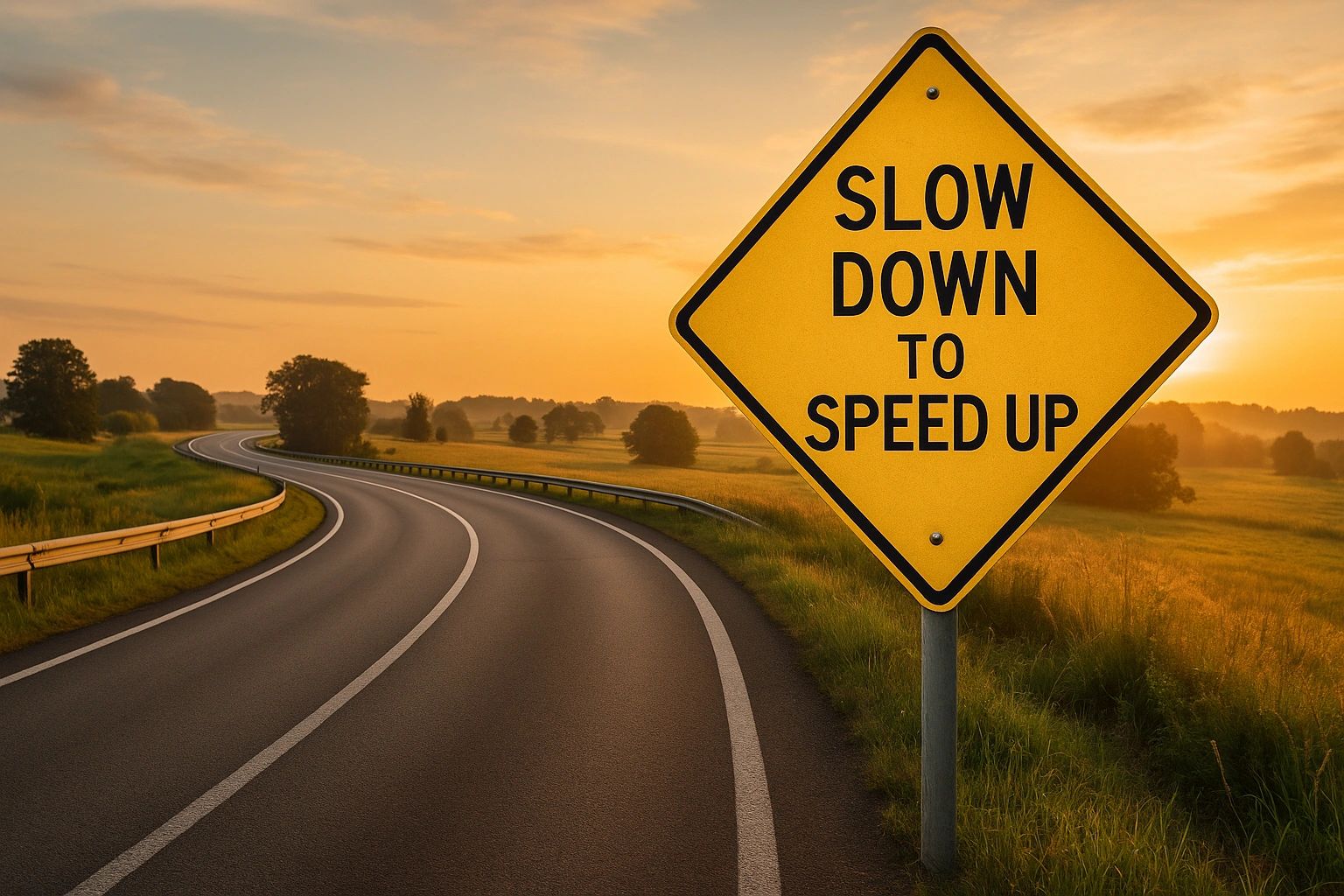
If you're like most people in modern business, your calendar probably looks like it lost a bet. Mine is a wall of blue about 2 weeks out. Even worse, it's a zebra calendar, as my colleague calls it. (Meetings with small breaks in between. So small, that you can't really accomplish anything meaningful in that time. Like the stripes of a zebra.) Between meetings, Slack messages, emails, and the never-ending to-do list that somehow regenerates like a Marvel villain, it's easy to believe that the only way forward is to speed up.
Do more. Move faster. Hustle harder. Sleep... Later... Maybe.
But what if the fastest way to make meaningful progress isn’t doing more? What if it's doing less? Or better yet, stopping, thinking, breathing, and then moving forward with actual intention?
That’s the power of a strategic pause.
Let’s spend just a little time exploring why slowing down might be the smartest, most productive thing you do all week.
Read on...
The Myth of Constant Motion
We’ve romanticized the idea of being busy. It’s the corporate equivalent of a badge of honor. You know the one:
"How are you?" "Oh, just slammed. Non-stop. You?"
We wear burnout like a status symbol, as if being perpetually frazzled means we’re important, in-demand, or doing something that matters.
But here’s the thing: Motion does not equal progress.
Running full speed in the wrong direction is still running in the wrong direction.
What Is a Strategic Pause?
A strategic pause is exactly what it sounds like: a deliberate break to reflect, reset, reassess, or realign. It’s not a vacation (though those are great too and hopefully all of you are taking advantage of that opportunity to recharge.). It’s a mental and sometimes operational slowdown that creates space for clarity, creativity, and better decision-making.
You don’t need to disappear to a cabin in the woods (unless that’s your thing or you have a manifesto to write.). A strategic pause might look like one of the following:
- Blocking 30 minutes to think instead of attend another meeting.
- Taking a walk without a podcast.
- Hitting pause before saying yes to a new project.
- Rethinking your roadmap with fresh eyes.
- Not opening your laptop before 9 a.m. (yes, it’s possible)
It’s not laziness. It’s leadership.
When Slowing Down Speeds You Up
Here are just a few ways that stepping off the hamster wheel can help you move more effectively:
1. Better Decisions
Rapid-fire decisions often lead to regrets. Strategic pauses give your brain the breathing room it needs to move from reaction to reflection. Even 10 minutes of stepping back can help you:
- Consider unintended consequences.
- Ask better questions.
- Loop in the right people.
- Avoid the "Why did we do that again?" conversation later.
2. Higher Quality Work
Ever spent hours working on something, only to discover that it wasn’t even needed?
Taking a pause upfront, to clarify the goal, the audience, and the actual need, can save you days of rework. You’ll create less waste and more value.
3. Creativity Needs Air
Creativity doesn’t thrive in chaos. Strategic pauses are where innovative ideas live. Shower thoughts? That's a strategic pause. That genius idea you had while walking your dog? That's a strategic pause too. (Also: you should walk your dog. They’re good for you and your furry friend will appreciate it too!)
Creativity is more likely to show up when your brain isn’t in survival mode. Give it space.
4. Team Alignment
Sometimes, the best move isn’t to sprint ahead, it’s to slow down and bring everyone with you.
- Is everyone aligned on the goals?
- Are we solving the right problem?
- Does anyone else need to weigh in?
A short strategic pause as a team can prevent weeks of going in different directions and then awkwardly converging in a post-mortem.
How to Build Strategic Pauses Into Your Life
(Without Quitting Your Job to Become a Monk)
You don’t need a sabbatical to benefit from slowing down. You just need a little intention.
Start With Micro-Pauses
You don’t need an hour. Try 5 minutes.
- Take a short walk after a meeting before jumping into the next.
- Mute your notifications and breathe.
- Stare out the window. (Yes, really.)
- Meditate. (I can't recommend this one enough.)
These moments reset your brain's focus and create a buffer between tasks.
Schedule Thinking Time Like a Meeting
Put it on your calendar. Defend it like it’s your annual bonus. Pro tip: Mark these times as private (so nobody can see the activity) and auto-decline meeting invites during this time.
This time is for strategy, reflection, and problem-solving. Or it could just be thinking without context-switching every 15 seconds.
Bonus: You’ll stop confusing motion with progress.
Embrace the "Slow Yes"
Not every decision needs to be made today. The world won’t end if you sleep on i. (And if it does, you probably weren’t going to fix it with a Slack message.) My manager is terrific in understanding how I prefer to operate. She plants the seed and then gives me space, knowing that I will spend some time reflecting, and then circle back with my response.
Pause. Reflect. Decide with confidence, not panic.
Practice Meeting Austerity
One of the best strategic pauses you can create is not scheduling the meeting in the first place. Or better yet, cancel one that serves no purpose. Lately I've been hell bent on applying this tip. An analysis of where I spend my time uncovered an OBSCENE amount of time in meetings, Slack messages, and email. (I highly recommend taking the time to break down where you've spent your time over the last 4 weeks. I bet you'll be shocked!). If a meeting can be handled async, I don't schedule it. If I am not going to get value from a meeting, or add to it, I decline it. Likewise if there's no agenda on the invitation. Harsh? Perhaps. But when time is limited, you need to use it wisely.
Again, I urge you to reflect on practicing meeting austerity. Your future self will thank you. So will your team. (Believe it or not.)
A Few Personal Examples (a.k.a. Lessons I Learned the Hard Way)
The Project That Should’ve Waited
Several years ago, I jumped headfirst into launching a new product feature because "momentum was good." We moved fast. We shipped fast. And then... you guessed it... it flopped.
Turns out, we misunderstood the customer need. A one-week strategic pause to gather additional and more diverse feedback could’ve saved us several weeks of wasted effort.
Lesson: Pausing to listen is not a delay—it’s insurance.
The Meeting-Free Morning
I started scheduling "work blocks" in the afternoon, every day. Just deep work or strategic thinking. I protect these blocks and only schedule a meeting over them if there is an emergency or my manager needs me. (I know who signs my paycheck after all.)
When I first implemented this practice, I felt guilty. Then, I started solving problems faster, communicating more clearly, and feeling less like a ping-pong ball.
Lesson: The business didn't shut down. Things still got done. My work improved and I didn't feel like I was about to buckle under the pressure of balancing everything.
What Slowing Down Is Not
To be clear, this is not a manifesto for procrastination or endless planning cycles. Slowing down doesn’t mean indecision or avoidance. It means **pausing **with purpose. (Perhaps that would have been a better title for this post.)
It’s a recalibration, not a retreat.
The goal isn’t to freeze. It’s to move forward with more intention, clarity, and confidence.
Signs You Might Need a Strategic Pause
Not sure if you need to hit that pause button? Here are some clues:
- Every decision feels urgent.
- You haven’t had an original thought in days.
- You’re solving the same problem repeatedly.
- Your team is busy but not effective.
- You respond to "How are you?" with an involuntary eye twitch.
Final Thoughts: The Best Leaders Aren't the Busiest
If you study high-performing leaders, they all share a similar trait: they know when to pause.
They don’t chase every shiny object. They don’t mistake panic for productivity. And they don’t confuse constant movement with forward momentum.
They slow down. They think. They choose. Then they act. Quickly, confidently, and with clarity.
So the next time you feel pressure to go faster, ask yourself:
"Is this the moment to speed up, or is it the moment to pause so I can speed up later?"
Your future self will know the answer. And your calendar might finally stop looking like a stress-induced fever dream.
Now, go take a walk.
Without your phone.
(You can thank me later.)
All the best
Mike
Continue exploring

January 27, 2026
What We Leave Behind in Ordinary Moments
For a long time, I thought kindness was something you decided to do. A conscious choice. A moment where you step up, do the right thing, and move on feeling pretty good about yourself. But the longer I pay attention, the...
October 28, 2025
The Art of Saying No
There’s a special kind of chaos that comes from saying “yes” too often. It’s the chaos that has you answering Slack messages at 9:47 p.m. while pretending to watch Ted Lasso for “self-care.” It’s the chaos that fills you...
September 3, 2025
Too Tired to Inspire, Too Stubborn to Quit
(Sometimes heroic effort looks like just getting out of bed.)