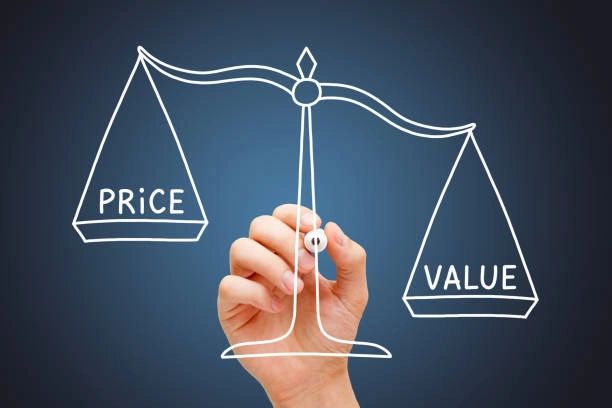
How to determine the optimal price for your product is one of the most critical, and in my opinion, one of the most difficult things to get correct in business. Price too low, and you're leaving money on the table and possibly damaging your brand by creating the perception that the quality of your product is poor. Price too high, and nobody will buy your product. To make the process even more difficult, the responsibility for setting pricing is somewhat fuzzy. Usually falling to the Product, Sales, and Marketing teams to define and manage, with nobody in complete control. It's quite a balancing act!
So how do you find the sweet spot when setting the price of your product? As I prepare to embark on an exercise to review the product pricing structure in my current role, I find myself reflecting on this very question and the various methods in which pricing can be determined. I decided to share my pricing thoughts in this blog to help those who may be going through a similar exercise, and quite frankly, it helps me clarify my thoughts when I write them down.
Why Customers Purchase a Product
Before I describe a few of the more common methods to determine price, it's valuable to take a moment to step back and think about the reasons why customers decide to purchase a product. First and foremost, customers are not buying your product. They are buying a result or an outcome by purchasing your product. As an example, no company needs marketing automation software. What they need are more customers. No company needs a recipe management tool. What they need is a more effective way to manage their kitchen and maximize their margins. Etc. In a nutshell, the customer has pain, and the customer is acquiring your product due to the products ability to help alleviate that pain. But this pain also provides an opportunity for your organization. If you can identify and empathize with the pain that your customer experiences, and then focus your product on how it will solve that pain, then you're well on your way to delivering an impactful product that your customers will feel is invaluable and be happy to pay for. (You've also taken a step toward value based pricing, which I will get to later in this post.)
It's important to understand the reasons why customers buy a product, and the reasons can be broken down into three broad outcomes. Functional. Emotional. Social.
Functional outcomes are essentially what your customer wants to accomplish and how your product helps them to do it. Most companies have a relatively decent understanding of this. I'm sure you've seen pricing pages, marketing material, sales demonstrations, etc. that are essentially a checklist of the capabilities included in a product. Certainly it's important that a customer understands the functionality of the product, and it does factor into their buying decision. But the two other outcomes, emotional and social, are equally, if not more important, in my opinion.
Emotional outcomes are the feelings that a customer experiences when they use your product. These could also be negative emotions that they no longer feel. As an example, does your customer feel a sense of relief because they no longer spend hours compiling and cleaning data, and now feel empowered because they can make quick and accurate business decisions. (removing a negative emotion and providing a positive one). Does a chef feel a sense of accomplishment because their margins have exceeded their financial target and they feel pride because of the positive reviews they're receiving due to the consistency they are now delivering. These are just two brief examples and I am sure you can come up with many emotional outcomes delivered by your product if you take a moment to reflect on it. (Go ahead, I'll wait.) Great. Now that you've come up with the emotional outcomes experienced by your customers, let me ask you a question. How do you know? Did you ask them? It's very important that you ask your customers to validate how your product makes them feel. Take the opportunity to email them. Send them a survey. Pick up the phone and call them. Etc. Whenever you interact with a customer, ask them how the product makes them feel. You'll gather some great insights from this exercise.
Social outcomes is how a user is perceived by his/her colleagues by using your product. Does the product allow them to uncover insights that when presented to the Executive team make them a hero? Are other restaurants in the chain envious because of the glowing reviews that the chef receives and are always asking her how she does it? We all love to feel good, and nothing makes us feel better in business than receiving accolades from management and colleagues. Social outcomes are changes in how a user is perceived by his/her peers. How they are regarded in the community at large. You should identify how your product helps elevate the users standing and creates a positive social outcome.
In addition to reaching out directly to to customers to gather the above insights, there's usually a treasure trove of information in your product usage data. By studying this data, you can discover trends and patterns that indicate the areas of your product that are resonating with customers and delivering the most value. As an example, by studying the usage patterns in my product, I can see that costing is a huge value provided to the customer and they come back to it often. These metrics are referred to as value metrics. That is, the value that is delivered to your customer by using your product. It's also the next topic that I will cover.
Value Metrics
Value metrics are the key to a product led go-to-market strategy. They are key because you are essentially aligning your revenue model with your customer acquisition model. These value metrics are critical to the way you define your product pricing and define your product metrics. Examples of value metrics might be "For YouTube, it might be the number of videos viewed" or "For Slack it could be the number of message sent" or "For Miro it may be the number of boards created". etc. Patrick Campbell, the CEO of ProfitWell puts value metrics into two categories,** functional metrics and outcome based metrics**. Functional metrics are metrics such as "per user", "per x videos", "per x uploads", etc. Pricing scales with the scaling of product usage. Outcome based metrics on the other hand scale based on the value of the outcome. As an example. "per x views", "per $x in revenue generated/saved". Many SaaS companies use feature differentiation to justify higher price points. (We've all seen the us vs. them feature/function checklists) But by following the feature differentiation approach, a SaaS company will usually experience a much high churn rate than companies that use value based metrics to drive pricing. In fact, ProfitWell estimates that a company using value based metrics experiences a churn rate that is ~70% less than companies that focus on features alone. Plus, companies that focus on outcome based metrics over function based metrics realize an additional 40% reduction in churn. As a note, outcome based metrics also deliver approximately 50% more expansion revenue than feature differentiated pricing.
According to Profitwell, there are three tests that a metric must pass for it to be considered a good value metric.
The metric must be easy for a customer to understand - Are you able to explain the metric to your customer? If the customer visits your pricing page, will he/she immediately understand the package that he/she should subscribe to and the value that they would receive? If not, you should look to another metric. If you are in a blue ocean (little to no competition), you will need to look to your data to identify the metrics. If you're in an established vertical with many competitors, look to the competition to see what value metrics are being used. They've done the research (hopefully) and customers within the space are already familiar with the metrics.
The metric aligns with the value that the customer actually receives in the product - You need to consider the low level activities that deliver the high-level outcome. As an example, in my product, a value metric is the ability for a chef to reduce ingredient costs and/or maximize their margins. This is accomplished by assigning accurate costs to a recipe. To do this, the user will load the actual costs from third-party suppliers into their ingredients/recipes. Therefore, to achieve the high-level goal of maximizing margins, the low level activity would be loading ingredient costs as they are received.
The metric must grow with the customers usage of the value - If the product delivers high value to the customer, then you can charge more for it. If it does not, then you will need to charge less. Continuing with my example above, the metric "reduce recipe cost and maximize the margin" would grow with the customer. The more costs that are loaded, the higher the potential to maximize the margin and reduce the costs for the applicable recipe.
As an aside, Patrick Campbell of Profitwell states that the biggest mistake many companies make is to settle on user based pricing. He states th_at "the reason per user pricing kills your growth and sets you up for long term failure is because it's rarely where the value is in your product"._ Think about it this way, if you get charged per user, are you going to share the product throughout the organization knowing you will be charged, or will you limit the product to a select few? (I can personally say that I have done this myself with several products. That is, limiting the number of users to a few power users to keep the monthly subscription fee low.) A great example of a company that avoided the temptation to price based on user count is Hubspot (and many other marketing automation platforms for that matter.) Hubspot doesn't charge a fee per user. They charge based on the number of contacts that a customer has in Hubspot. This is because the value of Hubspot lies in your ability to reach as many customers (contacts) as possible. Also, the more users that have access to Hubspot, the higher the likelihood that the number of contacts will increase as each user adds his/her contacts. This feeds the Hubspot revenue machine since pricing is based on the number of contacts, not users.
The bottom line is that for most organizations, user count is not where the value of the product is and user based pricing is not the approach that should be used.
Defining Your Value Metrics
Step 1 for me in defining the value metrics that will be used for my product is to brain dump all of the value metrics that I can think of. (and have my colleagues do the same.) Then, I will run them through the three tests that I outlined previously. The metric must be easy for a customer to understand. The Metrics aligns with the value delivered by the product. The metric must grow with the customers usage of the value. If the proposed value metric fails any of the 3 tests, it will be discarded.
Step 2 will be to review the usage data that is being captured in our product. I'll look to answer questions such as:
- What do our best customers use most in the product? (and what do they not use?)
- What features do my best customers use first when signing up?
- What does their user journey look like through the product?
- What is their frequency and duration of product use?
- What firmographic & demographic similarities exist between these customers.
- For a churned customer, what did they do that was different from my best customers?
- For a churned customer, why did they churn?
(You may notice that the questions above are a subset of the questions you would ask when defining your Ideal Customer Profile (ICP). Which should be another question you ask yourself, was the churned customer part of the target market?)
Step 3 will be to vet the shortlist with customers to ensure that the value metrics we've identified align with the perceived value held by the customers. To do this, a simple table will list the value metric on each row, and two columns "most preferred" and "least preferred" will allow the user to check one value metric as most preferred, and one value metric as least preferred. A pattern should emerge as you begin to obtain feedback from your customers.
It may seem like I've taken the scenic route to get to the discussion on pricing. But what I hope you've realized is that I've actually been speaking about pricing this whole time. It's critical that you understand the value of your product if you're going to set pricing properly and capture all of the revenue that you can.
Now let's dive into a few of the more common ways that SaaS companies set their pricing.
Common SaaS Pricing Methods
First, let me reiterate "common". There are dozens of methods used to price products, but what I am presenting below is a high-level overview of the four most common methods. At least from the perspective of my time in the industry. If you have additional methods that you've seen commonly used, feel free to share them in the comments.
Instinct, Gut, or Demand based pricing
Certainly not the most effective method of pricing, this method relies on the collective experience of the team to set pricing. Unfortunately, it's also one of the most commonly used methods that I've seen adopted. It comes down to a determination of what the team feels is reasonable, and supply and demand. If you're not making enough sales, then offer a discount. If you're making sales but can't provide adequate support for your product, then increase the price.
Competitor based pricing
This is also a common pricing model that I've seen used by many companies. Essentially, it requires that you research the pricing offered by your competitors and then offer your product at a similar price point. The problem with this approach is that you've made many assumptions. You've assumed that you have the exact same customers as your competitor. That their customers have the exact same pain points as your customers do. That you have an identical product to your competitors product. Finally, you make an assumption that your competitors actually knew what they were doing when they set their pricing. (Did they perform their due diligence speaking with customers and analyzing their usage data? Do you really want to take that chance?).
Cost plus pricing
This pricing model begins by first calculating the cost of good sold (COGS). From there, a profit margin is added to the cost to determine your price. While you may be making money (a margin) using this pricing method, you could be leaving a lot of money on the table. For example, imagine that you could be selling your subscription for $50 per month based on the value it delivers to the customer. However, the cost of providing the subscription is $10 per month and you decide to add an 80% margin to the $10 cost. (By the way, 80% is the minimum margin target for a strong SaaS company.) You'd end up charging your customer $18 per month, but you could have been charging $50 per month!
Value based pricing
Spoiler alert! This is the pricing method that I will be working through over the coming weeks and it's also the pricing method that this post has been leading to. There's no secret here. This pricing method bases the price of your product on the value that the customer receives from it. But not only will this pricing method help you maximize your profit margin, it will also inform you on what functionality should be included in each product tier.
If you are planning to use a pricing method other than value based pricing in your SaaS company, then you can stop reading now as the rest of this post will focus on value based pricing. But if you're serious about generating the most revenue possible from your product, then read on and I'll explain how you determine your price through market and customer research.
Note: If you're a young company and don't have many customers to tap into, then you may want to consider performing an economic value analysis. I am not going to go into the details here, but essentially an economic value analysis looks at the numbers that a company would expect to spend/earn using their current methodologies, and then calculating the expected savings/earnings if your product was used. As an example, If an analyst spent 8 hours pers week (at a fully loaded cost of $65/hr) creating a weekly report, but my product allowed them to create that same report in 1 hour, then my product would have saved the company $455 per week (7 x $65/hr). Based on the 10x rule, that is customers should receive 10x the value from the price they paid, we should charge just under $200 per month for our product. (($455*52)*.1)/12.
Value based pricing - Market & Customer research
The best way to determine the value of your product is to speak to customers. As I've mentioned in many previous blogs, it will never cease to amaze me how many organizations design products, create processes, set pricing, etc. without first speaking to their customers. I'm not sure what the phobia is, but I can assure you, most customers will jump at the opportunity to have their voices heard and help set the direction of your product. Don't be afraid to reach out to your customers, and when it comes to value based pricing, this outreach will be critical.
The model that I've grown fond of and plan to use in my current project is the Van Westendorp Price Sensitivity Meter, from this point forward known as the Van Westendorp model. This model is widely adopted by many of the most successful SaaS companies. This model is great because it doesn't provide a single value, but instead surfaces a range of prices for your product, which helps you avoid setting it too low (and missing out on revenue) or setting it too high (and losing sales).
There are three steps in this process and I will briefly outline each step below.
Step 1 - Create your questions
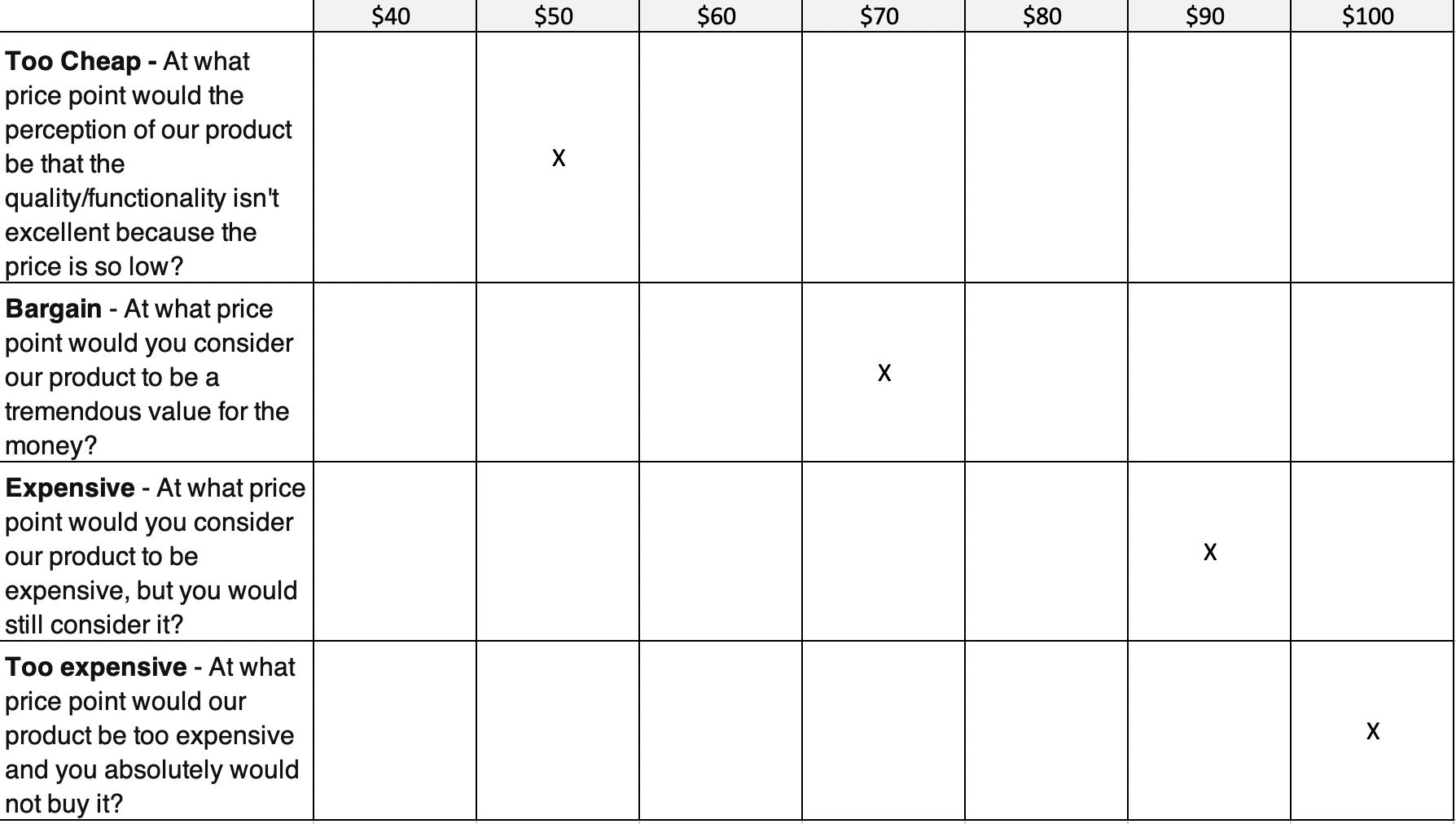
The Van Westendorp model proposes that four questions be asked of the customer. The purpose of these questions is to determine when a product becomes too expensive, or too cheap. As with most surveys, the more respondents that you get, the more accurate the results will be. The four questions are:
- Too Cheap - At what price point would the perception of our product be that the quality/functionality isn't excellent because the price is so low?
- Bargain - At what price point would you consider our product to be a tremendous value for the money?
- Expensive - At what price point would you feel our product is expensive, but you would still consider it?
- Too expensive - At what price point would our product be too expensive and you absolutely would not buy it?
Step 2 - Ask your questions
Now that you've formulated your questions, it's time to ask your customers for their response to the 4 questions. (and don't forget about prospective customers who may be in a product trial or using a freemium version.)
You can obtain this input through several different methods, but my favorites have always been surveys (in-app or email) or through live customer interviews. Keep in mind that if you do a live interview, you should have more discussion topics planned than just these 4 questions. When sending out a survey, it's easiest for customers if you provide a scale for them and simply allow them to check a box or move a slider to select the value. As an example, you may provide a table similar to the one below.
Step 3 - Analyze the results
As you begin to receive feedback from your customers, you'll want to begin analyzing the results. In the chart below, the x-axis values will be the price scale that you used in your survey. ($40 to $100 in the above example). The y-axis will be the percentage of customers that responded to each price level. Each line represents one of the 4 questions. As you begin to plot your data, you'll begin to see a chart similar to the example below appear.
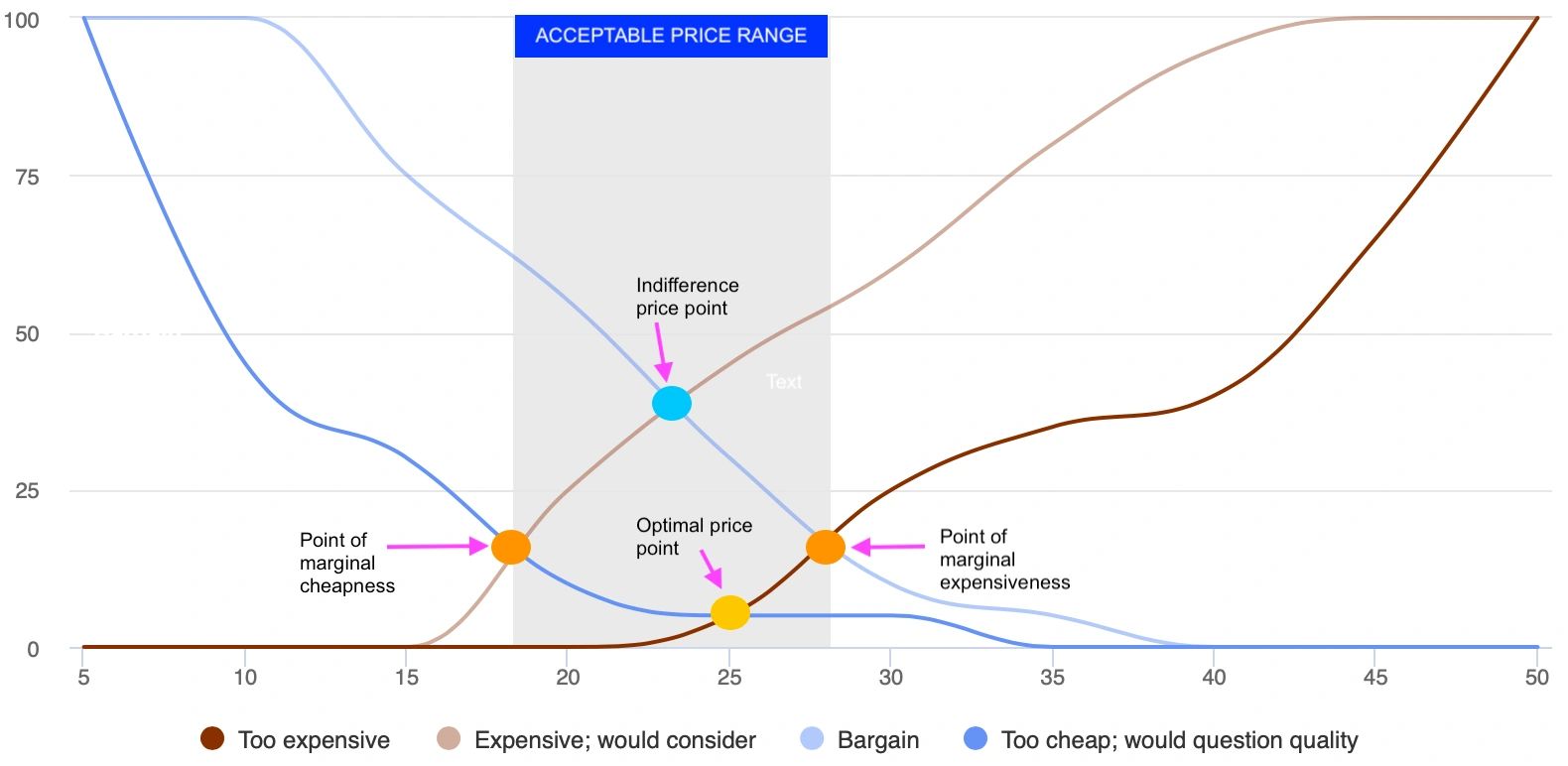
There are a few critical points of intersection on this chart that you should be looking for.
- The point of "marginal cheapness" - This is the intersection between customers who feel that the product is too cheap, but those customers are offset by an almost equal number of customers that feel the product is too expensive, but would still consider it. This is the lower limit of the price range.
- The point of "marginal expensiveness" - This is the intersection between customers who feel the product is too expensive, but these customers are offset by an almost equal number of customers that feel the product is a bargain. This is the upper limit of the price range.
- Optimal price point - This is the point where the too expensive and too cheap lines intersect. It is expected that only a small number of customers will not purchase the product at this price due to it being too cheap or too expensive. Note that this does not mean that the price is optimal for maximizing revenue. It is only optimal in that it will have the lowest number of customers rejecting the price.
- Indifference price point - This is the intersection between "expensive but would consider" and "bargain". This is the optimal revenue price point meaning that it is the price point that will attract the greatest number of customers.
As you perform the pricing exercise above, you should also segment the results by user persona as well as demographic and firmographic data. Finally, don't forget to look at the data through the lens of the various tiers that you offer. A customer on your higher priced platinum package will have a completely different perspective than a customer using your bronze package.
Now that you've determined your pricing, it's time to make those prices available to your customers. This could be done via a pricing page on your website, a one pager that you share with prospective customers, via an email, etc. Regardless of the method that you use to provide pricing information to your customer, it should follow a set of best practices.
In my next blog post, I'll present some of the ways that I have successfully structured pricing communication, as well as some other methods that I've seen used successfully by other organizations.
Wrapping it up
Hopefully this post has helped you align your thoughts around pricing and the approach that you will take. I know that writing it has helped me to begin reflecting on the 3 outcomes and value based pricing metrics for the products that I manage. Also, don't be afraid to brainstorm with team members. I don't have all of the answers and talking this through with my CEO and other colleagues will provide invaluable perspectives that I may not have considered. So, don't be afraid to ask for help and include others in your thought process.
Wishing you all the best
Mike
References:
Outcome Based Value Metrics Reduce Churn, Increase Revenue - Patrick Campbell - Profitwell
Continue exploring

August 17, 2026
When Architecture Becomes Experience
One of the more interesting things I’ve noticed over the years is that software companies and customers often define the word platform very differently.

July 28, 2026
The Best Product Ideas Don’t Care Who Thought of Them
Every product leader eventually finds themselves in a familiar situation. Someone with influence has a strong opinion about what the product should do next, and the organization has to decide whether that idea represents...

July 21, 2026
When a Suite Becomes a Platform
Spend enough time in enterprise software and you’ll eventually notice that certain words begin to lose their meaning. "Innovation" is one of them. "Transformation" is another. Lately, I think "platform" belongs on that l...