
How to Write Product Requirements That Engineers Don’t Hate
May 19, 2025
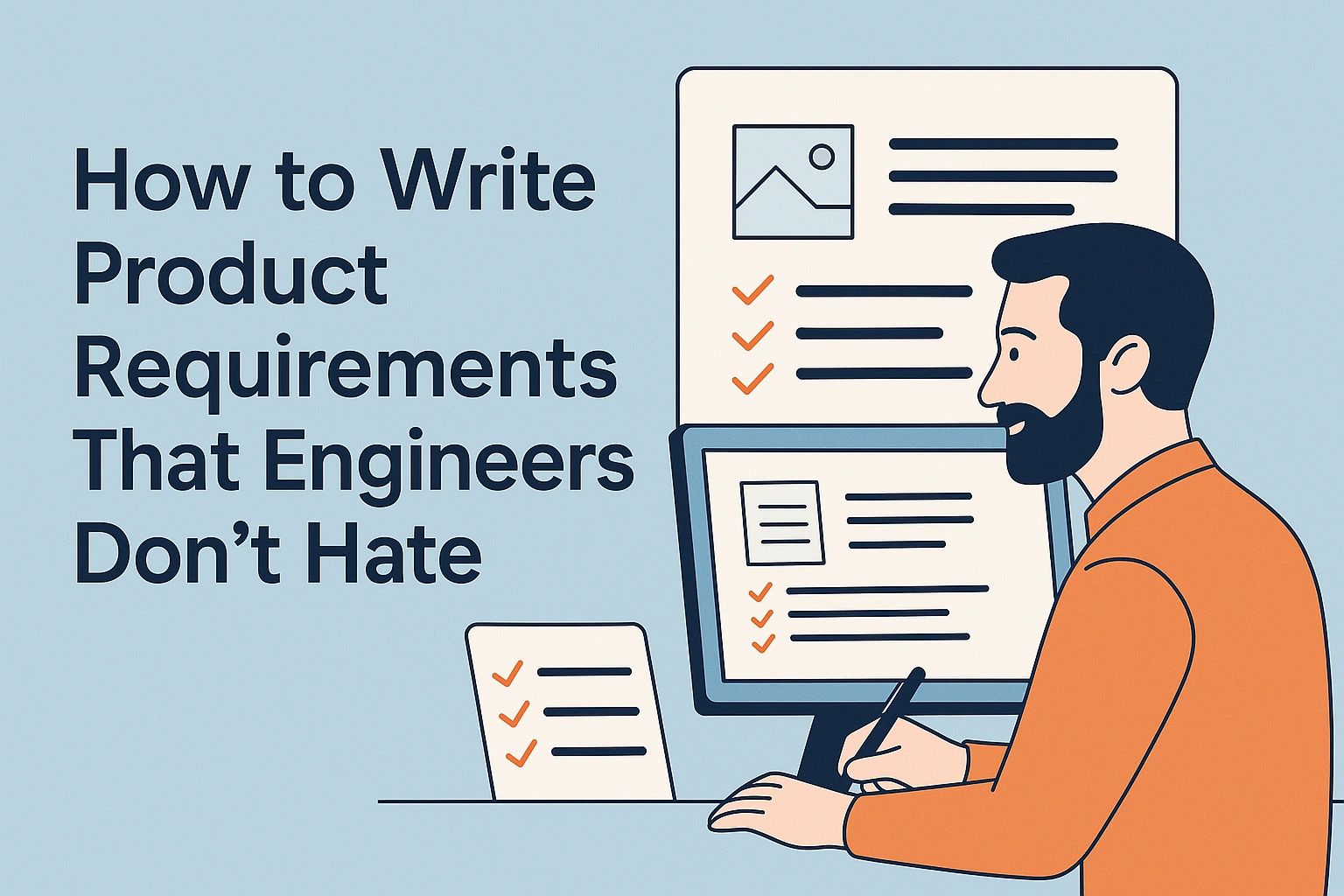
I've been thinking a lot lately about product requirements. If you're a Product Manager, you've probably been on both sides of the "requirements divide", either hearing that your specs are too vague or feeling frustrated that your detailed documents go unread. Writing product requirements that engineers don't hate isn't just about being thorough, it's about being effective. It's about communicating the right level of detail and the right structure**. ** Product requirements should foster collaboration and not be viewed as dictation.
Over the years (many), I've learned that good product requirements aren't about the document itself, they're about how they help cross-functional teams build the right thing, build it faster, and build it with fewer headaches.
In this post, I thought I'd share some of my reflections on a few tricks to write product requirements that Engineers won't hate.
1. Understand Your Audience (and Respect Their Time)
Product requirements are often written in a vacuum, crafted like manifestos without considering the people who need to use them. Remember that engineers are your primary audience. They're smart. They're busy. They're pragmatic. They want clarity, not verbosity.
Think of your PRD (Product Requirements Document) as a blueprint, not a novel. (Those who know me are probably chuckling at that statement!) Good engineers don’t want to guess what matters, they want to know what problem they’re solving, why it matters, and how success will be measured. Keep your tone professional, your sections organized, and your writing lean (skip the fluff).
Remember that your goal is to convey the what and the why and not to dazzle them with your linguistic gymnastics.
2. Start With the "Why"
Before diving into features or user flows, clearly state the problem you're solving and why it matters. Context is critical for good decision-making. Engineers are far more engaged when they understand how their work contributes to a larger goal. Engineers want to feel connected to their work and to do so, they need to understand the benefit of the work that they are doing. How does this align with the goals of the company? What customer problem(s) are being solved and how will this benefit them? etc. Gone are the days of slipping a pizza and a requirements document under a door to the Engineering team. (OK, I'm exaggerating. But there's no doubt that, as a whole, a connection to the work is more important to the Engineers of today.)
When you're laying out the "why" in your PRD, be sure to include:
- A short summary of the problem.
- The business or customer impact.
- Why now? (What triggered this requirement?).
By way of an example...
Bad example: "Add filter options to the search results page."
Better: "Users are abandoning search because they can’t easily find relevant results. Adding filters by category and price range will reduce bounce rate and improve conversion."
3. Define Success (Before You Define the Solution)
Instead of jumping straight into what the solution looks like, define what success means. This can be a combination of:
- KPIs or metrics (e.g., "Reduce search abandonment by 20%")
- User outcomes (e.g., "Users can find relevant search results in under 3 clicks")
- System-level results (e.g., "API response times stay under 200ms")
This allows the engineering team to help shape the solution and make technical decisions with the end goal in mind.
4. Be Precise Without Being Prescriptive
The best requirements leave room for engineering creativity while eliminating ambiguity. That means being clear about what the product needs to do, but not how it needs to do it (unless there's a technical constraint). Of all the tips in this post, I have found that this is the one that Product Managers struggle with the most. That is, the line between they what/why (Product), and the how/when (Engineering). Two major problems arise when you start down the how & when road.
- You cross the line into dictating how the solution will be implemented. I can assure you that most Engineering teams push back hard on this. If they don't push back, believe me, you've created negative feelings simmering below the surface. We all know what happens when an Engineering team is disgruntled. So just don't.
- YOU end up owning the solution. If it doesn't go right, then guess who's lap the blame lands in? Stick to the what & why, and leave the how & when to the experts. Being a former Engineer, I struggle with this one. It is even harder when you have a junior Engineering team and you just want to "help". Resist the urge and let your team do their thing. If you don't like their proposal, then question, challenge, and push-back. (Insert a funny "get out of my yard" picture in your brain here.) But don't deny them the opportunity to solve the problem.
To avoid the trap of crossing the how/when line, use structured sections such as:
- User stories or scenarios.
- Acceptance criteria.
- Edge cases and constraints.
Avoid vague or ambiguous language like "simple" or "intuitive." Define what those words mean in practical terms and be explicit in what you mean, especially if a request is open to interpretation. If you are using offshore resources, I cannot stress enough how explicit you need to be in your PRD.
Example:
- "The user should be able to filter search results by category and price"
- Acceptance Criteria:
- Category and price filters appear in left sidebar.
- Filters persist across page refresh.
- Price ranges are dynamically generated based on product data.
5. Use the Right Tools (and Keep It Current)
Where you write your requirements matters. Use tools that are collaborative, version-controlled, and close to the dev workflow. Confluence (my favorite), Notion (*grumbles*), Google Docs, or even GitHub markdown are all valid options depending on team culture and budget.
Most importantly, keep your PRDs living documents. If engineering discovers a constraint or you learn something new from user testing or additional research, update the document, ASAP. Nothing frustrates teams (or leadership) more than chasing a spec that’s out of date. I cannot stress this one enough so I will repeat it...update the PRD as soon as something changes!
6. Collaborate Early, Not Late
Writing requirements in isolation and throwing them over the wall (or slipping them under the door with a pizza) is a sure way to alienate your engineers. Involve engineering before the doc is finished. Share your thinking. Invite feedback. Ask them what questions they would have.
Good and early collaboration on your PRD results in:
- Smarter trade-offs.
- Fewer missed edge cases.
- Better estimation and planning.
Most importantly, it builds trust. Engineers feel like partners, not just executors. (pizza, door...you get the gist.)
7. Document Assumptions and Decisions
Engineers are detail-oriented. They don’t just want to know what the product should do, they want to know why it does it that way, or why you want to do it that way.
Be sure that when writing your PRD that you call out:
- Assumptions you made (e.g., "Most users browse on mobile").
- Decisions and trade-offs (e.g., "We chose drop-downs instead of sliders to reduce complexity").
- Out-of-scope items (e.g.,_ "Filtering by rating is out of scope for this release"_).
This prevents confusion, rework, and revisiting old conversations. Plus, when you get to be my age, it helps you remember why you made the decisions you did.
8. Provide User Context (But Don’t Overdo It)
Engineers are often removed from users. Your job is to bridge that gap without overwhelming them with research decks. In cases where the Engineering team doesn't seem to "get it", or they're just really interested in user input, I'll invite them to a call with a user to hear the information first hand. I once had an Engineering team that wasn't taking performance and scalability seriously. When I got the team on a call with an impacted customer, they quickly understood (and felt) the pain of the customer and quickly shifted their focus. (I don't recommend this hostile approach often, but in this particular case, it was a last resort. Plus there were other dynamics at play in this particular organization that I won't get into in this post...but I digress...)
When providing user context in your PRD, be sure to include:
- Persona summaries.
- Brief user stories.
- Quotes or support tickets (sparingly).
A little user empathy goes a long way. It helps engineers make better micro-decisions throughout implementation. You may also want to consider adding this information into the appendix and placing a reference (link) to the appendix in your document. It's often difficult to work this user context into your PRD without disrupting the flow.
9. Align on Edge Cases and Constraints
Many product specs fall apart in the gray areas. Anticipating edge cases makes development smoother and avoids costly back-and-forth. Consider which edge cases do and do not matter. Especially in your MLP (Minimum Lovable Product) version. It's completely acceptable to gather additional data on those edge cases and then circle back to address them in a later release if needed. But be sure to communicate your thought process behind these decisions to the Engineering team so that they understand what matters and what doesn't, and where any trade-offs were made.
10. Be Honest About Unknowns
You don’t need to have all the answers before you share your PRD with the Engineering team. In fact, pretending that you do creates risk and undermines trust. If you do not have all the answers or designs, be sure to clearly indicate this in your PRD.
Note items as TBD (To Be Determined). Use phrases like:
- "Needs further validation"
- "Pending feedback from design"
- "Estimate impact with real usage data post-launch"
Good engineers will appreciate your transparency and help you reduce the unknowns. They may also be able to help you fill in some of these blanks in your PRD.
11. Write Like a Human
You're not writing a spec for a robot. You’re writing it for talented, curious people who want to do their best work.
Keep your PRD, clear, concise, and free of jargon.
Use bullet points, headings, font colors, and whitespace. If it looks like a textbook, no one will read it. (I guarantee it.)
Just like this section.
12. Include a TL;DR and Checklist
Start your doc with a quick summary. (Note that a TL;DR should be at the top of the document, not at the bottom where it will be discovered after the document has been read.) The TL;DR summary should include:
- Goal
- Problem
- Proposed solution
- Success criteria
Also, be sure to end your PRD with a checklist that includes items such as:
- UI mocks approved.
- API contract defined.
- Edge cases documented.
- Success metrics agreed on.
This will help a busy team find the most important parts fast and not waste time wading through the details of the document to do so.
Final Thoughts
Writing product requirements that engineers don’t hate isn’t about spoon-feeding instructions or writing volumes of text. It’s about enabling thoughtful execution. When done well, your PRD becomes a catalyst for alignment, innovation, and momentum and not a static artifact or a box-checking exercise.
It’s about helping engineering teams do what they do best, that is, solving problems with elegant code, by providing the right information, the right way, and at the right time. Clear and collaborative requirements create the space for engineers to focus on implementation without ambiguity or rework. They foster shared understanding, reduce friction, increase sense of ownership, and accelerate delivery.
A good PRD also builds trust. It shows that you value the engineering team's time and expertise. It communicates that you've thought through the use cases, constraints, and trade-offs. Most importantly, it invites partnership rather than prescription.
So the next time you sit down to write a PRD, don’t just ask: "Did I cover everything?" Ask: "Would I want to build this if I were reading this doc?"
If the answer is yes, you're doing it right, and your team will thank you for it.
Happy writing.
All the best
Mike
Previous
Stop Wasting Time, Start Owning Your Day
Next
How Generative AI Is Reshaping Product Management
Continue exploring

August 17, 2026
When Architecture Becomes Experience
One of the more interesting things I’ve noticed over the years is that software companies and customers often define the word platform very differently.

July 28, 2026
The Best Product Ideas Don’t Care Who Thought of Them
Every product leader eventually finds themselves in a familiar situation. Someone with influence has a strong opinion about what the product should do next, and the organization has to decide whether that idea represents...
July 21, 2026
When a Suite Becomes a Platform
Spend enough time in enterprise software and you’ll eventually notice that certain words begin to lose their meaning. "Innovation" is one of them. "Transformation" is another. Lately, I think "platform" belongs on that l...