

I wanted to touch on a subject in this blog that has been the topic of countless boardroom discussions and when failing to manage it correctly, has stymied the potential growth of many organizations. That is, how to manage hyper-growth.
So first and foremost, what is hyper-growth. It sounds like something that every business should aspire to, and it is, if it's managed correctly. Hyper-growth is a period of rapid expansion that companies experience as they scale. It's generally accepted that hyper-growth is when a company's compound annual growth rate (CAGR) is 40% or higher. This period lies between a company's early phase (start up) and before the company has fully matured. Think of it as a company's chaotic teenage years in which it experiences constant childhood regression but tells anyone who will listen that it's an adult now. It is this transition, and some of the difficultes pertaining to the Product organization that I am going to write about today.
Having worked in several hyper-growth organizations and having had many clients that are/were in this stage of growth, I've seen a few common patterns, *cough* challenges, come up over and over again.
Before I dive into these challenges I should state that this stage of a company's growth is my favorite time to be part of an organization. Why you ask?
- The company is stable enough that I don't have to worry if my paycheck is going to clear, but it's not so mature that it's mired down in established processes.
- It's a time where formal teams are being established and people are beginning to have designated "seats on the bus".
- It's a time of innovation. The initial product has been established and it's time to come up with the next big trick(s).
- Increasing amounts of cash is being injected by investors, who are expecting a return on that investment.
- The market knows who you are and what you have to offer, and they're signing up for it.
- It's a time where the old way of doing things no longer scales and new processes must be implemented and this, in my humble opinion, is the crux of the hyper-growth challenge. I'll repeat it for those in the back, it's a time where the old way of doing things no longer scales and new processes must be implemented. This challenge applies across the entirety of the organization, but as I've mentioned, I am going to speak specifically about the challenge from a Product team perspective.
First off, kudos to the team who led the organization through the start up phase. I'm sure it was a turbulent ride with A LOT of late nights. (I've been there, done that, and got the burn out too. I feel ya.). But what got you here, isn't going to get you where you need to go next. Hero's don't scale and it's time to work smarter. (Notice I didn't say "not harder". There's still a ton of hard work ahead.)
The Team
One of the first things you need to do is ensure that the entire organization understands why these changes must happen if the organization is to grow. You also need to be prepared that not everyone will be willing or able to make this transition. You will have attrition and you will also need to be prepared to make the difficult decision to remove anyone who doesn't want to be part of the next chapter. Harsh reality. But dragging along team members who undermine, obstruct, and constantly challenge the change is the same as dragging an anchor behind you. Even worse, this negativity can spread like a cancer to other team members, and it needs to be cut out, STAT! It's a tough call, but don't let it linger. I've seen this drag on for months and years until eventually the entire Product & Engineering team is in complete turmoil and the wheels are essentially falling off of the bus (application). Put on your "big boy/girl pants" and make the tough calls quickly. You need a team that is fully on board and understands why these changes are being made.
I'll also add that in many orgs, I've seen an almost entire turnover of the management team as this phase begins. It's not uncommon to bring in seasoned experts who have been through this phase of an organization's growth. From the CEO, through other C-level execs, VPs, and Directors. It's important that that leaders who have previously navigated the hyper-growth phase are in place to share that knowledge.
Prioritize
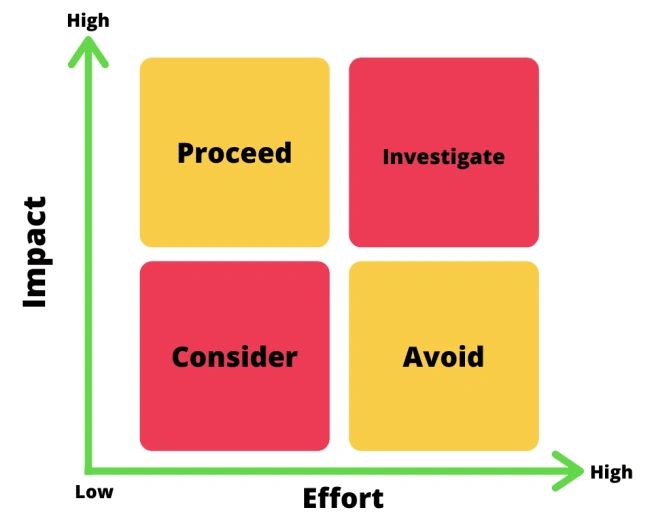
You can't boil the ocean and you can't implement everything all at once. Prioritize the processes you need to change or implement based on the impact to the organization and the effort to implement it. You're going to come up with a ton of changes that need to happen and it's easy to get drawn into biting off more than you can chew. (You'll end up moving 20 balls one-yard at a time.) I'd recommend making a list of the changes you'd like to implement and then lay them out on an Action Priority Matrix. This chart plots effort against impact and helps to identify the quick wins (which you should focus on first) vs. the tasks you should avoid, or at least leave until the end. An example of this matrix is shown in the image below. (Product Manager BONUS: This matrix is great for prioritizing product work too!.)
Execute
So where should you start? That completely depends on your unique situation. I've had to implement Agile development processes, bug/incident escalation processes, Product strategy frameworks, cross-team communication processes, and everything in-between. Keep in mind the size of the undertaking as well and be sure to break it into manageable work efforts that can be implemented quickly. Look for manual processes that wouldn't be able to scale without the addition of headcount. Are there similar processes that can be combined? Is there a tool that can automate a repeated process? As you roll out these processes, especially automated ones, be sure to think about how you will safeguard these processes so that if they fail, you can easily recover, and the impact to your customers is as minimal as possible.
Also keep in mind that changes can be done in phases. You don't need to implement a fully automated process in phase 1. You can create several phases that incrementally build on the improvements made previously.
It's important that you make progress and that people see, and feel, that progress is being made.
Be Ready to Fail
Huh? Yes, that's right. Be ready to fail. Not every plan you make is going to go exactly as expected, and some may even fail in their entirety. What is important here is that you, and the team, are willing to try something, but be willing to raise your hand and say "well that didn't go exactly as expected. How can we improve it?". It is crucial to fail fast, be willing to accept those failures, and learn from them to improve. Countless times I've seen vanity come into play and processes continue to be followed even though they are not yielding the expected results. (or because a textbook said that this was the way to do it.) Remember that your organization is unique and there will be no cookie cutter solution for you. Be willing to blend what works for your organization into your own unique process.
Be Data Driven
Cliche? Probably. But the decisions you make from now on must be based on facts (data). From how you decide what you are going to build, to how you build it, to measuring the success of what you've built. Data will be at the heart of this. You can't just pay lip service to being a data driven organization. You have to live it. Everyone in the organization needs to be part of it. Be open and transparent. Make data available to all. Many, many times I've had team members come to me with something that they've noticed in the data that turns out to be a major opportunity for the organization or heads off a calamity. The more eyes on the data, the better.
Just like the processes you'll be enhancing or implementing, there is a lot that you can do with your data. Be sure to prioritize the work in the same manner that I shared earlier and most importantly, look at it from the perspective of the problem that you are trying to solve or the question that you are trying to answer. (top down approach) Too often I've seen customers running around with data trying to figure out what to build with it. (bottom up). Rarely does this approach work. I've pontificated about this in other posts, so I won't belabor the point here. Just don't do it, please. Always identify the problem or question first and then seek out the data to answer it.
Remember, it's a Marathon, not a Sprint
Be prepared that these changes may take months or years to fully implement. The amount of change that is ahead of you will not be completed overnight. That is why it's important to plan the work and then work the plan.
Plan, execute, measure, learn, repeat.
In Closing
These are just a few of the suggestions I would make for an organization entering their hyper-growth phase. Again, it's a time where the old way of doing things no longer scales and new processes must be implemented. It's vitally important that the entire organization is on board with the changes that are coming otherwise it will be an exhausting battle to do what needs to be done to help the organization scale.
Be sure to share successes with everyone, and be willing to admit defeat and adjust. Use data to plan, execute, and review your progress.
Have fun. It's an exciting time full of opportunity.
Remember, you're all in this together.
Wishing you all the best
Mike
PS. Feel free to drop any additional thoughts in the comments to help other readers that may be entering this phase of their growth.
Continue exploring

August 17, 2026
When Architecture Becomes Experience
One of the more interesting things I’ve noticed over the years is that software companies and customers often define the word platform very differently.

July 28, 2026
The Best Product Ideas Don’t Care Who Thought of Them
Every product leader eventually finds themselves in a familiar situation. Someone with influence has a strong opinion about what the product should do next, and the organization has to decide whether that idea represents...

July 21, 2026
When a Suite Becomes a Platform
Spend enough time in enterprise software and you’ll eventually notice that certain words begin to lose their meaning. "Innovation" is one of them. "Transformation" is another. Lately, I think "platform" belongs on that l...