For those of you that have read my blog post Staying Sane In An Insane World, you will recall that I am socially awkward, but determined to become less so. To help me progress, I've signed up for an on-line program that matches me with other professionals for one-on-one discussions. It's been great, and I've met some really interesting people. Since I provided my interests when signing up, at least 2/3 of the professionals I am matched with are in the Product Management space. In speaking with these Product Managers, I've noticed an alarming trend, and one that they, themselves, point out. A lack of connecting with the customer to identify, understand, and address their needs.
The conversations have gone something like this:
Me: "So how are you creating your product roadmap and what drives your backlog?"
PM: "The Product Team comes up with ideas."
Me: "Based on what?"
PM: "Looking at our competitors. Speaking with industry analysts. Sales thinks they can sell something. The CEO has an idea. etc."
Me: "Do you ever ask the customer what they need?"
PM: "We'd like to, and we know that we should do it far more often, but we just don't have time."
What the what?!?! Now, don't get me wrong here. Monitoring the competition and anticipating market trends is part of a Product Manager's job, and should be used to inform the product roadmap. However, not understanding the needs of the customer is a pretty fundamental mistake, and almost always leads to unhappy customers and churn. The customer should, no, the customer must be at the core of everything that you do. That's called Customer Centricity.
Another common mistake I see are companies that create user personas and rely on these one dimensional, fake people to drive their product needs. (Suzy Student, Danny Developer, Mary Manager, etc.) Personas are great if you've actually spoken to customers and based the personas on them (and periodically refresh them). But far too often I've seen user personas created in a vacuum and product decisions are then based on the assumptions made when creating the persona. I don't know about you, but I prefer to drive my product decisions by speaking with actual people rather than a make believe character. (My invisible friend Charlie feels the same way.)
To help you become more customer centric, I wanted to share a few tactics that I use to help facilitate the flow of information from the customer to the Product team (and vice-versa).
Pick up the phone/email
I've put this first because it's surprising to me how many people have a phobia about simply reaching out to the customer and asking what they need. (and I am the one that is socially awkward). I've attended many meetings in which participants began speculating about the customer, debating their needs and how they should be addressed. I would finally break in and ask "well, has anyone actually spoken with the customer(s) to see what they think?". This is usually met with blank stares and mumbling. Just...pick...up...the...phone! Believe me, customers love to provide feedback. They love to be involved. Most importantly, they love products that actually solve their business problems, and the only way for you to really know what their problems are, is to ask them.
In-app Feedback
Another great way for you to get customer feedback is to prompt for it within the application. This should not be intrusive or overdone. Customers are using your application to perform a task, not to provide feedback to you, so use this sparingly. There are many tools available that will allow you to add this functionality into your application. Currently, my team is using an app called Pendo to collect user feedback. A word of warning here; much of the input that you will receive through in-app feedback will be negative. Users will rarely stop what they are doing to give you positive feedback, but you better believe that they are going to jump at the opportunity to let you know what they think if they're currently experiencing a problem in your application. Just remember that all customer feedback is good and provides you with an opportunity improve the customer experience.
Idea submission portal
Another tool that I utilize is an idea submission portal. For this, I use Aha! Ideas!. Aha! is a great product management tool, that also happens to have a built in ideas portal. What's really nice about this particular ideas portal, is that not only can users add ideas and vote on them, but the idea is automatically added to your product backlog for review. Easy peasy.
Customer Advisory Board/Focus Groups
A Customer Advisory Board or CAB is a great way to get your customers involved in vetting your strategy and product ideas, providing input on marketing and sales pitches, and helping to formulate solutions to industry problems. Unlike one-on-one calls with customers, a CAB will allow members to hear the thoughts of other customers and engage in discussion. (sometimes quite spirited). CAB members attend periodic meetings and typically serve for a set period of time before rotating off. (I.e., 1 to 2 years), CAB members should also be representative of different segments of your customer base. (I.e., small/medium/large companies, different geographies, different verticals, etc.) Typically, 10-12 CAB members should give you a sufficient representation and still allow for all voices to be heard.
Product Council
The Product Council allows for different teams to have a seat at the Product table. This does not mean that the product roadmap is dictated by a committee. Instead, the intent is to foster the bidirectional flow of information between Product and the other teams in the organization, officially. I say officially because the Product team should always be communicating with other teams in the organization. Each team (Sales, Engineering, Finance, Marketing, Services, Support, etc.) has 1 representative or seat on the Council, with a team alternate should the primary representative not be able to attend a meeting. Our Product Council meets monthly with a slightly longer quarterly meeting so that the revised product roadmap (which you may have guessed, we revise quarterly) can be presented to the Council. At every meeting, each Council representative brings 3 questions and 3 ideas to present to the Council. This input typically comes from their teams interaction with the customer, therefore, not only is the Product Council great for ensuring that there is official, bidirectional communication happening, but it provides additional customer input for consideration by the Product team. One other thing to note about our Council. No C-level participation is allowed. This is done so that each Council member is comfortable in voicing his/her opinion, and there isn't head nodding whenever a C-level Executive speaks.
Interviews
My team and I regularly conduct interviews with our customers. The interview is performed to solicit feedback on our products, understand more about their organization, and uncover business challenges that they face (which creates an opportunity for us to help solve them). To start, we identify a segment of our customer base that we'd like to speak to, and then send an email inviting their team to participate in a 30-minute call with one of our Product Managers to get their input. We have awesome customers so we've been pretty successful in finding customers that are willing to participate.
One note for the interviews. Always have a script prepared in advance so that you only collect beneficial information and that you are collecting it consistently across all of your customers. Be sure to keep the questions open ended. By doing this, you hear the thoughts of the customer and you aren't steering them. (I.e., by selecting a multiple choice option). Practice active listening and record the session (if possible).
Surveys
Surveys are another great way to get customer feedback. Quite often, I will send surveys to customers who were not able to participate in an interview, or did not respond to my invitation. (I usually pick up an additional 10% of the interview invitees by doing this). There are many tools available to create surveys, and my favorite (currently) is Google Forms. It's free, no frills, and it captures all of the data for me. Like the interview, surveys should focus on capturing only information that will be beneficial to you, so give it some thought. Most importantly, surveys should be short. I try to keep a survey to 10 questions or less, and when sending out the survey link and invitation, I mention that it is only 10 questions, will take just a couple of minutes to complete, and will only be available for a limited period of time. You can further entice customers by holding a prize drawing for anyone that submits a completed survey. (Indeed, a little bribe never hurts.)
Field Studies
Depending on the industry you are in, you may want to observe users in their environment through field studies. This entails watching users perform their daily duties and documenting their processes. (I have been hit by flying chickens doing this. Seriously.) This can be at the micro level, watching them perform a specific task, or at the macro level where you observe their general process(es). This may be performed live where the Product Manager is physically present, or via tools such as Fullstory (which I currently use) which will record the users interactions for later viewing by you. Thank you @Fullstory for saving me from another chicken beat down.
Diaries
If you are not able to observe a user directly, you could use a diary. This requires a user to document his/her processes as they go about their day. I use this technique frequently when I have users participating in a private preview (beta) program. This is not an open ended diary and I'm not interested in what the user had for lunch. Instead, I provide the template of specific tasks and functions that I would like them to observe and record. It makes it much easier for the user to digest what you expect of them, and it provides consistency across all of the input received.
OKRs
As a Product team leader, I am in a position to determine the OKRs (Objectives & Key Results) that each Product team member aims for every quarter. One of the OKRs that I set regularly is that the Product Manager must speak directly with a set number of customers. These are one-on-one customer calls (interviews) and follow the recommendations that I've made in the Interviews section above. It's been a really great way to keep customer communication at the top of the Product Manager's mind. (That and my incessant nagging.)
To recap, while understanding your competition and market direction are necessary product inputs, it is the customer that should at the center of everything that you do. If you're creating products in a vacuum, based on assumptions that you've made on your customer's needs, then you're setting yourself up for failure. Reach out to your customers and simply ask what they need. It will be a win for you, a win for your organization, and a win for the customer. Everyone wins! Create a customer centric culture in your organization.
I'll end with one of my personal tenets on Product Management.
"I do not subscribe to "build it and they will come". Instead, I believe that "understand what they need and then deliver it" is the best way to create wildly successful products."
I truly believe this, and so do my Product teams.
Wishing you all the best
Mike
If you're interested, the online one-on-one program is called Lunch Club.
Continue exploring

August 17, 2026
When Architecture Becomes Experience
One of the more interesting things I’ve noticed over the years is that software companies and customers often define the word platform very differently.

July 28, 2026
The Best Product Ideas Don’t Care Who Thought of Them
Every product leader eventually finds themselves in a familiar situation. Someone with influence has a strong opinion about what the product should do next, and the organization has to decide whether that idea represents...
July 21, 2026
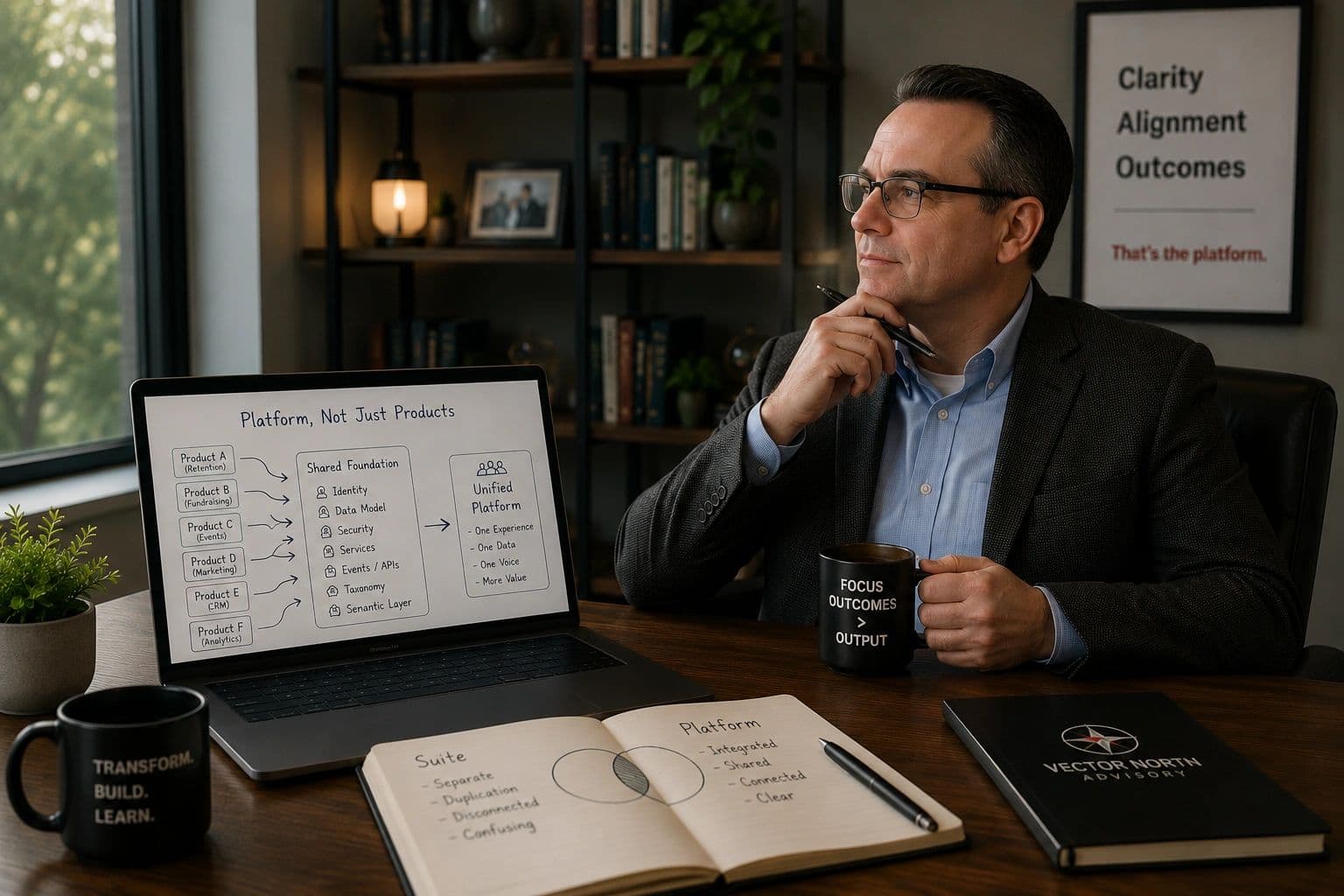
When a Suite Becomes a Platform
Spend enough time in enterprise software and you’ll eventually notice that certain words begin to lose their meaning. "Innovation" is one of them. "Transformation" is another. Lately, I think "platform" belongs on that l...