
In my last post, I discussed how businesses are drowning in data and unable to take full advantage of the benefits that it will bring to the organization. Benefits such as:
- An average increase in profit of 8% (Source: BARC Research)
- An average cost saving of 10% (Source: BARC Research)
- An average yearly growth of 30% (Source: Forrester)
Not to mention improved strategic decisions, improved operational processes, and a better understanding of their customers.
In fact, analysts estimate that only about 1% of the data that we have available to us is being leveraged for any meaningful purpose. The remaining 99% of this data sits idle, costing organizations money to store, and costing even more in lost opportunity. This is best described in one of my favorite quotes:
Data is the new oil. Like oil, the value of data lies in what you do with it. Unless it's broken down and refined, data has no value.
So why is this happening when there’s so much potential upside? It’s certainly not because businesses don't want to take advantage of this opportunity. Who doesn't want increased revenue and decreased cost? It’s because businesses don’t know where they want to go, the path that they should take to get there, or even how to begin their analytics journey.
Over my career, I've worked with hundreds of organizations in defining and delivering their business intelligence aka analytics solutions. While working with these organizations, what became apparent to me is that most of them make the same mistakes over and over again. It doesn't matter the size of the organization, the vertical that they serve, their geographic location, etc. They all make one or more of the same mistakes. Here are a few of the common mistakes that I‘ve seen cause project failure, in no particular order:
- Selecting a tool/software/architecture before they've identified the problem(s) that they are trying to solve. (a potential waste of money if the tool doesn’t solve the real problems of the organization)
- Looking at data first, and then trying to figure out what to build with it. (looking for a problem to fit the solution)
- No executive sponsorship or corporate champion for the project.
- Not instilling a data driven culture across the organization.
- Design and development being done in a vacuum by the IT team. (delivering a solution that doesn’t serve the needs of the users)
- Trying to boil the ocean. (trying to solve every problem at once)
- No clear focus or deliverables.
- No communication plan between the business and technical resources.
- No data management plan.
As I worked with these organizations to help them define where they wanted to go and how to get there, I noticed that I was going through the same motions with each of them. I was hearing the same problems and I was recommending the same solutions. Over time, I developed a standard process to help these organizations lay out their analytics plan and greatly increase the probability of a successful analytics project. This repeatable process is called the Business Intelligence Blueprint. In all of the analytics solution implementations that I performed, the Business Intelligence Blueprint was always a prerequisite. No technical or architecture decisions were made, no design or development was done without this blueprint in hand. Just like you would not attempt to build a house without a blueprint, so too should you not begin to build your analytics solution without one.
I am going to share my experience and some of the key parts of the process over three blog posts. This first post will focus on several tasks that should be completed before you move into the fact gathering phase of your project. This is a very important phase and helps set you up to successfully create your own Business Intelligence Blueprint.
Preparation
Obtaining executive sponsorship is critical. Remember, this is a discovery project and you are not looking for approval on a 6 figure software spend (at this time). What you are seeking is a sponsor who:
- Understands the importance of leveraging data to make timely and informed business decisions. The sponsor should be willing to support a data driven culture.
- Will ensure that the resources you require, primarily people, are available and invest the time required to provide meaningful input.
- Would like to better understand the needs of the business, and believes that having a well researched and structured, top-down plan will increase the probability of a successful analytics project.
If it hasn't already been determined for you, it's important to focus on a specific department or area of the business. Remember, you are not trying to boil the ocean, but instead want very targeted solution(s) that are going to have the highest positive impact on the business. I've seen many organizations that want to create a solution for the manufacturing team, HR, finance, distribution, etc. all in one pass. No bueno. So how do you know which department or area to select if it hasn't already been provided to you? Ask. Begin with your executive sponsor and work your way through the rest of the management team. They may all represent different departments, but I guarantee you that if you speak to multiple stakeholders, you will begin to hear the same area(s) mentioned. I am sure there is room for improvement in all areas of the business, but the management team should be able to point you toward the most problematic ones or the area with the highest possible benefit.
Once you've identified the department(s) or area(s) that you are going to begin with, it's time to identify the resources (people) that are going to be required from each department. To do this, you can look at an org chart, but I've found that the best approach is to simply ask. To get the right resources, reach out to the head of each department or area that you are targeting. Explain the project that you're about to embark on, the value that it will bring to the organization, and mention the executive sponsorship that you secured. Explain that you are looking for the best resources on the team who can describe the challenges that they face in conducting their duties and how these challenges might be best solved through an analytics solution. I tell the department head that I will typically need about 2 hours of time from each resource over a two week period to prepare the Business Intelligence Blueprint. This includes the initial interview and any required follow ups for clarifications and deliverable review.
Now that you have the list of resources, you should send each resource an email:
- Introduce yourself if they do not already know you.
- Explain the project and the importance to the organization. You are interested in identifying the problems that they encounter in their job. You should mention that you are looking specifically at reporting, analytics, metrics, etc. (however you’d like to phrase this), but don’t dissuade the resource from documenting other challenges as well. There’s gold in them there hills and you’re going to uncover a lot of other beneficial feedback for the organization, completely unrelated to your analytics project. Do not propose dashboards, technologies, or any solutions at this point because you do not yet know what the problems are, and what will solve them. You just want to understand their pain points.
- That they have been identified as a key resource with critical knowledge required to make the project successful.
- That you will need about 2 hours of their time spread over a two week period.
- Ask that they spend the next week or two documenting the challenges they encounter while performing their duties. They should document these as they arise with as much detail as possible. Doing this prep-work will save you time during the interview and help ensure that all of the challenges are being surfaced. (Not just the ones that they remember during your meeting or that occured within the past day or two.). They should be looking for challenges such as reports that they create (especially the ones that require manual effort), metrics that they cannot obtain easily or obtain at all, data issues that they wrestle with, data sources and systems that they interact with, issues in their current processes, capturing "I wish I was able to...” moments, etc. If they have reports that they can send you in advance of the one-on-one meeting (discussed next) that's even better because it allows you to review and formulate questions prior to meeting with the resource.
- Let them know that the first step will be to have a one-on-one interview to discuss their pain points. To provide adequate time for documenting challenges, as noted above, this meeting should be scheduled one to two weeks in the future. I cannot stress enough the importance of conducting this meeting in a one-on-one setting. Initially, I thought I would save time by including all team members, but this quickly devolved into the participants trying to talk each other out of why something is/isn't a problem, why something isn't important, lessons in how to accomplish the problematic task, etc. This completely derails the conversation and provides little to no useful information from the session. Also, some people are introverts and some people are extroverts. If you mix them together in this conversation, the introverts will say very little and you may miss some valuable information. In fact, I am so strict on this rule, that I will walk away from the project if one-on-one meetings are not permitted. But what if you receive conflicting information? Then you will circle back to confirm and reconcile the information, and flag it as a potential training opportunity for the organization.
Be sure to schedule the project sponsor in the first interview spot to confirm the scope and deliverables and to get the lay of the land. Interviewees should then be business stakeholders with IT/technical resources coming last.
So, let's recap where we are in preparation process.
Sponsor. Check.
Department(s)/area(s) identified. Check.
Resources identified. Check
Expectations set. Check.
At this point, in preparation for the one-on-one sessions that you have scheduled, you should begin pulling together any tools and material that you are going to use during the sessions. Here's a quick checklist of the items that I like to have with me when I conduct these interviews.
- A tool to easily capture notes. My preference is Microsoft OneNote. I like this tool because not only can I capture notes and store any collateral provided, but I can record the session to create my notes at a later time. This way I am listening and engaged in the conversation, and not taking notes.
- Samples of charts, graphs, dashboards, etc. Although you are not going to propose any solutions in this discussion, I've found that many people don't understand analytics terminologies and/or can't articulate what they're referring to/asking for. Having these visual cues helps the conversation.
- A whiteboard and markers.
- An example of a past Business Intelligence Blueprint. (anonymized of course.). This may not be possible if this is your first project, or if you're doing this as part of an internal project at your company. However, I will provide a sample Business Intelligence Blueprint in the third and final blog in this series.
As you draw near to the time of these interviews, be sure that you send out a reminder to each participant. I like to send these 1 week in advance (because sometimes the participant has forgotten to capture challenges and this reminder will light a fire under their ass.), 3 days in advance, and then the day before the interview. Also make sure that you have reserved a private, and quiet room in which to conduct the interview. (there's nothing worse than being interrupted during the interview or being hit by flying chickens. Yes, that really did happen to me during one of my sessions.)
In my next blog, I'll describe the one-on-one interview process and how to capture, reconcile, and prepare your notes which will be used to create your deliverable, the Business Intelligence Blueprint.
Thanks for reading.
Mike
One final note. Below is a link to access a sample interview agenda. Note that there are additional notes in this document that are not mentioned in this blog post. I would highly recommend that you review the agenda to get these additional insights.
Continue exploring
July 21, 2026
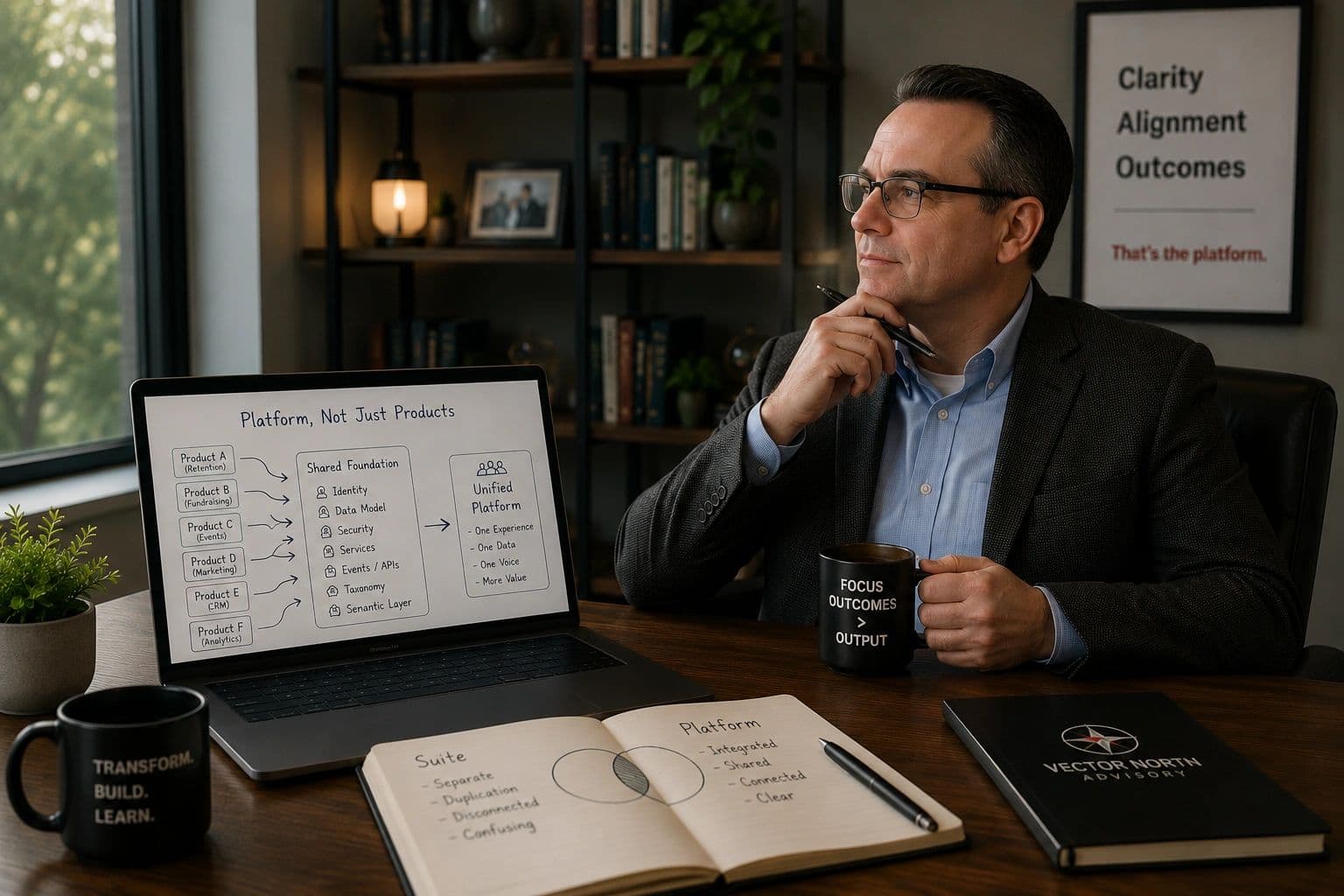
When a Suite Becomes a Platform
Spend enough time in enterprise software and you’ll eventually notice that certain words begin to lose their meaning. "Innovation" is one of them. "Transformation" is another. Lately, I think "platform" belongs on that l...
December 2, 2025
"AI Duct Tape" Isn't An AI Strategy
Why bolting AI on isn’t the same as building AI-first (and why your product can tell the difference).

June 2, 2025
AI & The Product Manager
Let me begin by stating that I am SUPER excited about Artificial Intelligence (AI) and the possibilities that it provides. The ability of these tools to create images, text, music, computer code, etc. is just mind boggli...