

In my previous blog, The Business Intelligence Blueprint Pt.1, I described several of the key steps that should be taken to prepare for the interview process. These steps include:
- Obtaining Executive sponsorship.
- Determining the department(s) or area(s) of the business that you will focus on.
- Identifying key resources that you will need to interview to gather information about the challenges that should be addressed in the blueprint.
- Collecting the tools that you will need to conduct the interviews.
This blog focuses on the activities and processes that are followed to gather information from the key resources you’ve identified. This information is used as input to create the Business Intelligence Blueprint. The consolidation of this information and creation of the Business Intelligence Blueprint document will be described in the third and final blog in this series.
Setting Up The Interview Environment
There are several important steps that should be taken to facilitate a smooth interview process.
- Ensure that all of your interviews are conducted one-on-one. It is very difficult to connect with the interviewee and have an open dialogue when there are numerous people in the room. Especially if management is present.
- Secure a meeting room or a private space where you won’t be disturbed. The interviewee should be focused on your discussion, not responding to colleagues.
- The first interview should be with the project sponsor. During this interview you should review the process that will be followed and reconfirm the expected outcome of the blueprint engagement. Go over the interview agenda and ask if there’s anything to share about any of the interviewees. (I.e., someone who is very opinionated or resistant to change, someone that feels their job is being threatened by the project, someone who is fixated on a particular problem, etc.). It’s always better to know what you’re walking into so that you can prepare.
- Have all of your tools ready. Whiteboard is clean and markers are available (and working!). If you’re using OneNote or other software to capture your notes, have it ready to go and a separate page created for all interviewees. Pen and paper if you want to kick it old school. If possible, a computer with access to the systems you are going to be discussing. It’s much easier for an interviewee to show you what they are talking about then to “imagine if you will...”
- Make sure you have everything you need personally (I.e., water, mints, coffee, etc.) You’re going to be doing a lot of talking and I’d recommend you also have a few cough drops on hand for when your voice starts to sound like puberty 2.0 during your 5th interview.
- Turn off your mobile phone and shut down your email. You‘re here to listen, the world will manage without you for a few hours. Trust me.
Conducting the Interview
Your first interviewee arrives, looking like a deer caught in the headlights and wondering what to expect. It’s important that you begin by introducing yourself and take a couple of minutes to explain the process that you are following. Share that they are key to creating a successful Business Intelligence Blueprint, and how important this project is to the organization. If the interviewee was identified by the sponsor as concerned about their job, I usually spend an extra minute explaining how a project such as this will allow them to focus more on analyzing information, than on gathering and massaging data. This analysis is much more valuable to the organization than being a data farmer.
I also like to mention that as they describe their challenges and needs, that they don’t think about them in the context of the data or systems that they may or may not have. Be forewarned, you are going to receive requirements for data and/or systems that the organization doesn’t currently have. But this is ok. While it may not be solvable at this time or through an analytics solution, it’s great input for the organization to perhaps spin up a separate project to address the need. I’ve had many organizations modify their business processes, acquire additional software, and work to capture missing data based on this feedback. It makes your Business Intelligence Blueprint all the more valuable. If you’re creating this blueprint as a service provided from an outside organization, it‘s also an opportunity for you to potentially pick up some additional work. Cha-ching!
If you are going to record the session, which I always do and strongly recommend that you do as well, I ask the interviewee for permission to do so. I always state that it will be used for my note creation only and I will not provide the recording to anyone else. I do this because I would rather be engaged in the conversation than taking notes. I can honestly say that I’ve never had someone ask me not to record the session. (But they have asked me not to give the recording to their boss!)
It’s time to rock ‘n roll, hit that record button.
Ask the interviewee to state their name, title, and provide a brief description of their job duties. Then ask if they’ve had an opportunity to document some of the challenges that they face while performing their job duties. Since you’ve assigned this homework in advance, the majority will come prepared. I find that about 3/4 of the interviewees come with this information in hand. For those who do not, ask them to take a moment to reflect on the difficulties that they face in their job and/or any ideas for improvement that they can suggest.
Buckle up because you are about to get a barrage of information. Here’s the key to doing this successfully. Have empathy. Let the interviewee unload their frustrations. Connect with them. Be empathetic. (see my previous blog on Empathy) This will go a long way in making the interviewee comfortable and get them to open up further. Some people get very animated and it’s important to remember that this is not personal. (Unless you wrote that ”piece of crap ERP system that is never right and makes me spend 2 hours a day manually correcting data”...then it probably is personal). Let them vent for a bit, but then gently guide them back to the matter of gathering information.
You are also going to hear about problems that really can’t be solved by a business intelligence solution. Process problems, systems that don’t work correctly, persistent errors, manual processes, etc. This is all great information and I still capture it and add it to a special section in the document that describes other business improvement opportunities. As I mentioned previously, this provides additional value to the organization and potentially for you if you're a service provider who has been hired by the organization to create the blueprint. But what is important here is that you don’t let it go on too long. Let the interviewee know that you‘ve documented the issue and that you will ensure it’s surfaced to management, but you need to focus on the topic at hand.
As the interviewee talks, it‘s important that you practice active listening. If you’re talking more than 1/3 of the time, then you are talking too much. You are listening for problems that can be solved by a business intelligence solution. Things like incorrect or missing reports or key performance indicators (KPI). Manual reporting and data gathering processes. Information that the interviewee wished he/she had, but are unable to get in their current systems. Ask questions. Probe for details. How would the interviewee solve the issue? What sort of metrics would be beneficial to them? Why would it be beneficial to the organization? How do they currently get the information? Are they aware of where the data comes from (data source(s))? Do they know of any issues with the data? Etc. This should be a naturally flowing conversation with the interviewee laying out the problems/needs, and you leading them toward the solution, which quite frankly they usually already know, but just don’t know how to articulate it.
I look at this process in the same way that a therapist treats a patient. What are the problems and then ask probing questions to uncover the cause and possible solutions. Unfortunately, I can’t script exactly what to say as each situation is different and requires a different approach. What I can say is that this process get easier as you continue to conduct the interviews and begin to hear the same requests and processes, which develops your understanding of how the business works. Practice makes perfect and this is certainly no exception to that rule.
Upon completing the interview, be sure to thank the interviewee for their time, ask them if you may contact them with any additional follow up question, and let them know that you will send them a copy of the takeaways from your conversation. It’s important that you send this summary as it provides you with a check on the accuracy of the information that you captured,
Once you’ve spoken with all of the business stakeholders, it’s time to conduct the same process with the IT/technical team. In addition to the aforementioned topics, I also like to begin vetting some of what I’ve heard from the business users with the technical team. I.e. “Mary in HR was mentioning that she has a hard time getting visibility into time card data. tell me a little about the system(s) that you use and the data.”. From here, the conversation will uncover systems used and data sources, limitations in the applications, data quality issues, integration detail, etc.
Your goal in the interview sessions with the technical team is to create a high level topology of the systems and data sources and how they fit together. You‘ll also begin to create a data quality plan and better understand data lineage. This is important information when selecting the right set of tools and laying out the roadmap.
Here’s an example of a simple, high-level topology from a previous project. (names changed to protect the innocent)
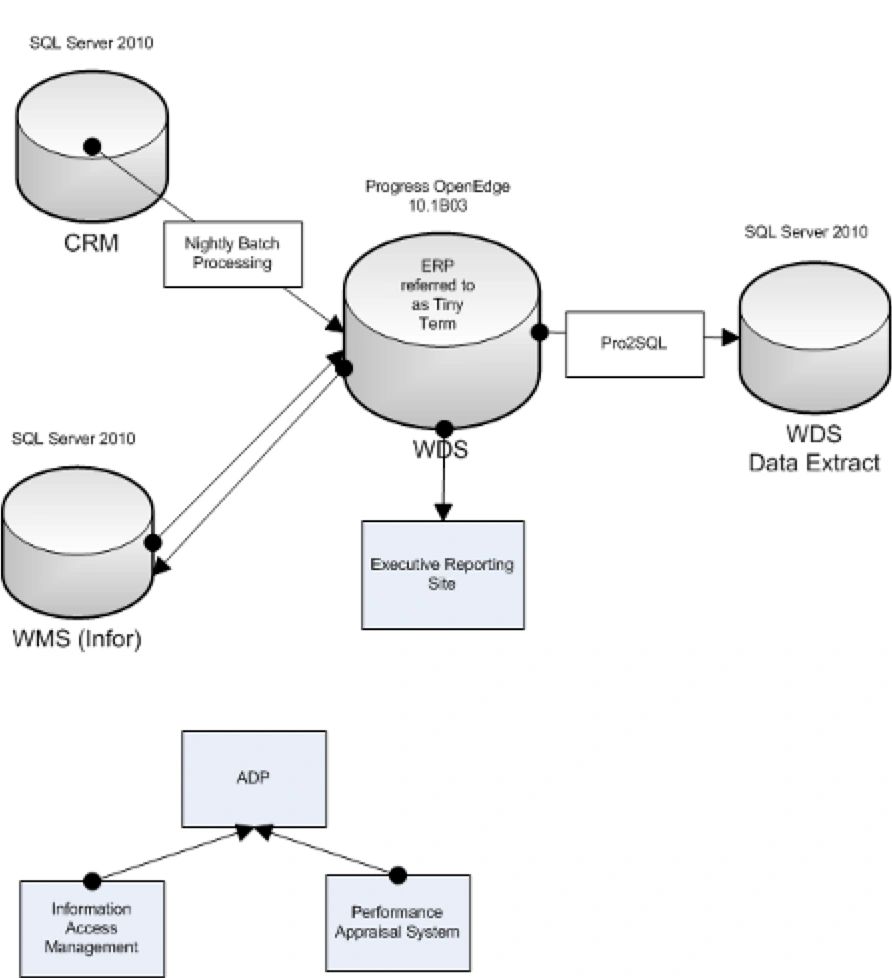
I've included a snippet of notes that I captured during a session from a previous project. You can find a link to review this information at the bottom of the page.
Post Interview
First, have a drink. You probably need it. My record was 40 people interviewed for a large project. But the number of interviewees is usually in the neighborhood of 6 to 10 depending on the size of the organization and the department(s) or area(s) you are focusing on.
Now, “relive the magic”. Go back and listen to the recordings and make your notes. This is important for several reasons:
- To reinforce what you’ve heard.
- To identify contradictions in the information provided during the interviews. (When you identify these, reach out to the corresponding interviewees for clarification. You may have misunderstood or there really may be conflicting information. You need to ensure that you're working with accurate information, so dig in. Your investigation may uncover an opportunity for the organization to improve their training if one of the interviewees doesn't fully understand how a process or system works. These training opportunities should also be included in the blueprint, but don't mention any interviewee by name.)
- To locate overlaps or common requests. (These have the potential to be your most far reaching and impactful deliverables.)
- To support the recommendations that you will be making in the Business Intelligence Blueprint.
- To have a written record of your conversation which should be provided to each interviewee. This aids in confirming the accuracy of what you’ve heard. Which brings me to the next step.
As promised to each interviewee, send a copy of the notes you captured for their particular interview. Be sure to thank them once again (manners will get you far in life) and ask that they confirm the accuracy of what you’ve written, or point out anything that you missed. It’s a good idea to put a deadline, usually 1 week, to provide this feedback. State that you will assume everything is accurate if you don’t hear back within the specified time period.
You now find yourself awash in pages and pages of data. So, what’s next you ask? It's time to create the blueprint, but you’ll need to wait until my next blog, the Business Intelligence Blueprint - Pt.3 to find out how to pull it all together.
Thanks as always for reading.
All the best
Mike
As I mentioned above, I’ve sanitized some of the notes that I‘ve taken from a past project to give you a sense of the information you should be looking to capture. You can download these sample notes by clicking here.
Continue exploring
July 21, 2026
When a Suite Becomes a Platform
Spend enough time in enterprise software and you’ll eventually notice that certain words begin to lose their meaning. "Innovation" is one of them. "Transformation" is another. Lately, I think "platform" belongs on that l...
December 2, 2025
"AI Duct Tape" Isn't An AI Strategy
Why bolting AI on isn’t the same as building AI-first (and why your product can tell the difference).

June 2, 2025
AI & The Product Manager
Let me begin by stating that I am SUPER excited about Artificial Intelligence (AI) and the possibilities that it provides. The ability of these tools to create images, text, music, computer code, etc. is just mind boggli...