
There are many tools in a Product Manager's tool belt. In this blog, I'm going to describe a tool that has great benefits, but one that I've found is used by a very small number of Product teams. You may have guessed by the title of this post that I'm referring to a strategy canvas.
What is a strategy canvas you ask? In its most basic form, a strategy canvas is simply a line graph that groups functionality together, and then ranks the maturity or importance of each functionality group. It also overlays a comparison to competitors or industry benchmarks for the same functionality groups. This allows you to quickly and easily see where your product stands in comparison to the competition and/or industry standards.
I've included an example of a strategy canvas below for reference, based on bogus or made up information. Your strategy canvas will of course have different groups of functionality based on what your product does, as well as the names of actual competitors or industry standard organizations. You may have more or less functional groupings and/or competitors than shown in the example. Point being, it will be unique for every organization.
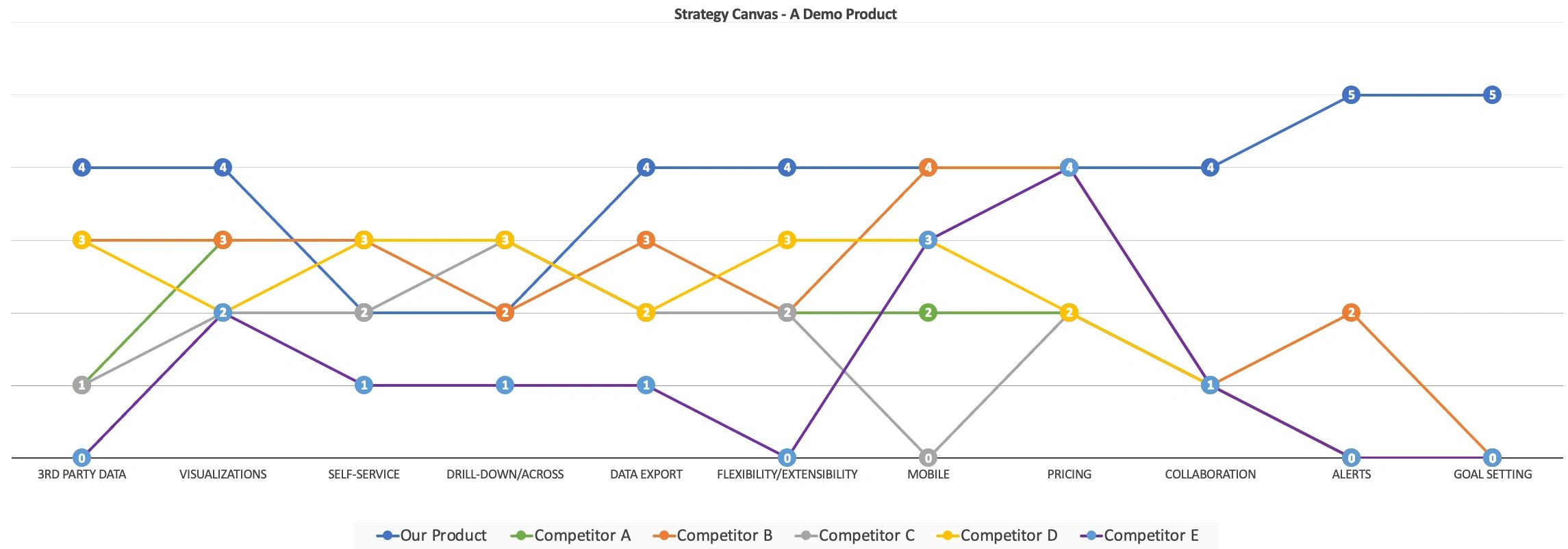
The strategy canvas is a tool that I introduced to my current product team a couple of years ago. It has become part of our quarterly product workshops in which we discuss product strategy, revisit our product roadmap, and make any changes required. The strategy canvas has proven to be invaluable part of this discussion because it very quickly allows the team to see areas in which we are falling behind, areas in which we're ahead of the competition, and because we also review these historically, areas in which the competition is making advances. But more on that final point later.
So, as I look at the strategy canvas above, what does it tell me?
First, I should explain the numerical scale that you see. A zero indicates functionality that does not exist. A five is awarded for top-notch, best of breed, knocked it out of the park kind of functionality. Admittedly, these values are subjective. It's important that you thoroughly research the capabilities of your competitors, or industry benchmarks, and be honest in your assessment. We all have a tendency to want to elevate our company while knocking down our competitors, but you must avoid doing this to get the real value out of the strategy canvas. One of the ways that my team avoids this is that all of the Product Managers know that they will need to defend their position during our product workshop. All Product team members challenge the values asking why the number was given and pointing out any other information that is known about the competitor which may alter the given rank. I can honestly say that I have never held a workshop in which we didn't collectively adjust some of these values. (and sometimes even added new categories of functionality that we felt were important to track.)
But back to what the strategy canvas example tells me...
Well, I can immediately see that we probably need to put some focus on self-service and drill-down functionality, as indicated by the red box in the image below. I can also quickly see that we're dominating the competition when it comes to collaboration, alerts, and goal setting capabilities, as indicated by the blue box in the image below. We're also ahead in the other categories, but not by much, so we should keep our eye on these areas as the competition could quickly catch up or overtake us.
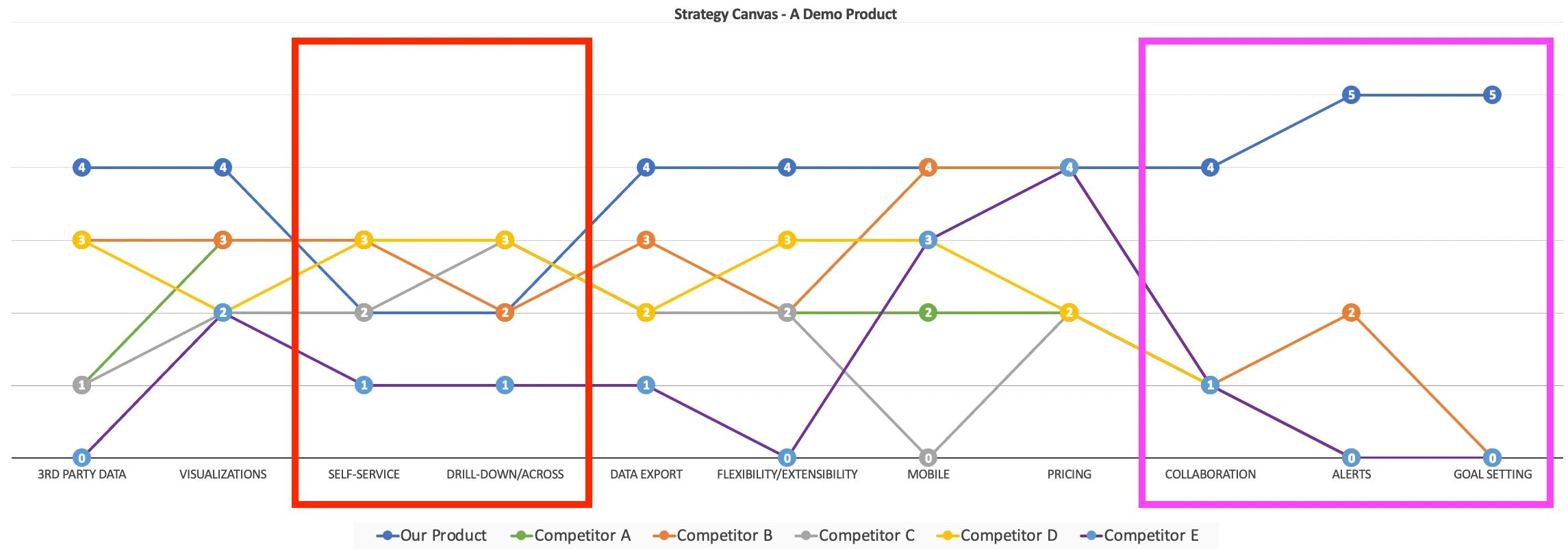
This information helps guide our product roadmap from a competitive perspective. Not only is it helpful for the Product team, but it also allows us to easily illustrate to other departments within the organization why we're making some of our roadmap decisions. (Have you ever tried to present a competitive matrix to an Executive? Trust me if you have not, the strategy canvas is much more easily digested.). In presenting the strategy canvas to outside groups, I will quite often show a before and after picture of our position. I.e., here's how we rank today, and here's how we will rank after we've made enhancement x, y, & z. It really delivers a powerful message.
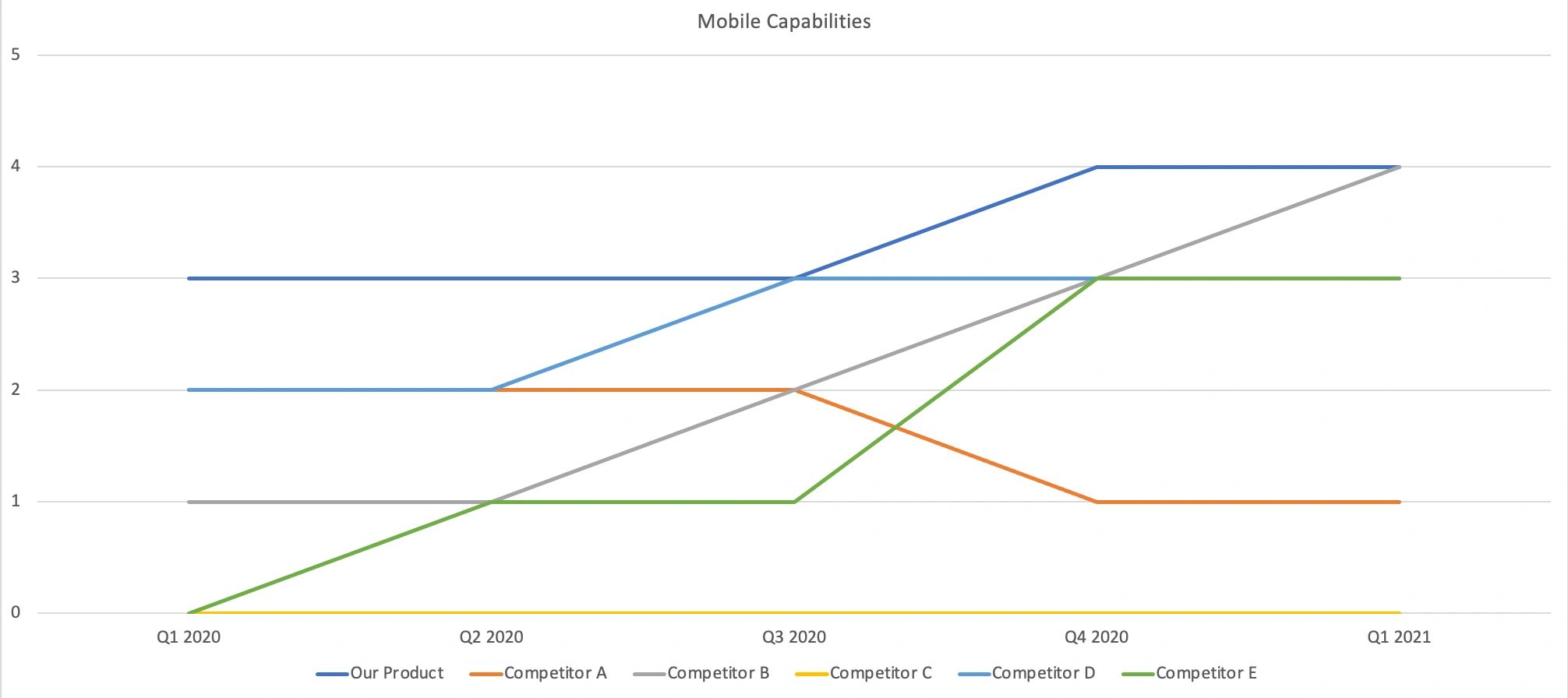
Over time, our strategy canvas has evolved. As an example, we've added markers to indicate rankings on previous strategy canvas documents so that we can track changes. This could be an increase or a decrease to the ranking. Decreases happen when the market has advanced their capabilities but a competitor (or gulp!, your product) has not. You may also decrease a rank based on new information or to correct errors. Again, you want to maximize the benefit of the strategy canvas by ensuring the accuracy and the timeliness of the data. During our quarterly workshops, we review past and current strategy canvas documents and discuss any changes that we are seeing. Are competitors increasing their rank because they're innovating? Is our product evolving as expected and are we closing gaps in which we're behind, or increasing the gaps in areas in which we excel? We also discuss areas in which we have opportunities to differentiate ourselves from the competition. Is there something that nobody else does, which we could do, and claim as a competitive differentiator? You may even want to create a separate line chart for each functional area, broken down by competitor showing their progression over time. See an example of this below for one of the sample functional groupings, Mobile Capabilities. (Watch out for competitor B & E. They are on a mission and looking to eat your lunch!)
More recently, we've added additional information that illustrates where we aspire to be in the coming period. This could be the coming release, the coming quarter, or for the year. In our case, we typically use the quarter. So, as we look at the items on our product roadmap, we plot where we will rank if we deliver all of the features that we've identified. There are two caveats to this. First, that we deliver everything that we've planned on the roadmap. Second, that competitors remain stationary. However, we all know that this is never the case and they will also be innovating. If you have visibility into a competitors roadmap, you can plot how those changes will affect the competitors rank. But more often than not, you will not have this insight which further reinforces the importance of reviewing and updating the strategy canvas on a regular basis. I've included an image below to illustrate the aspirational plots.
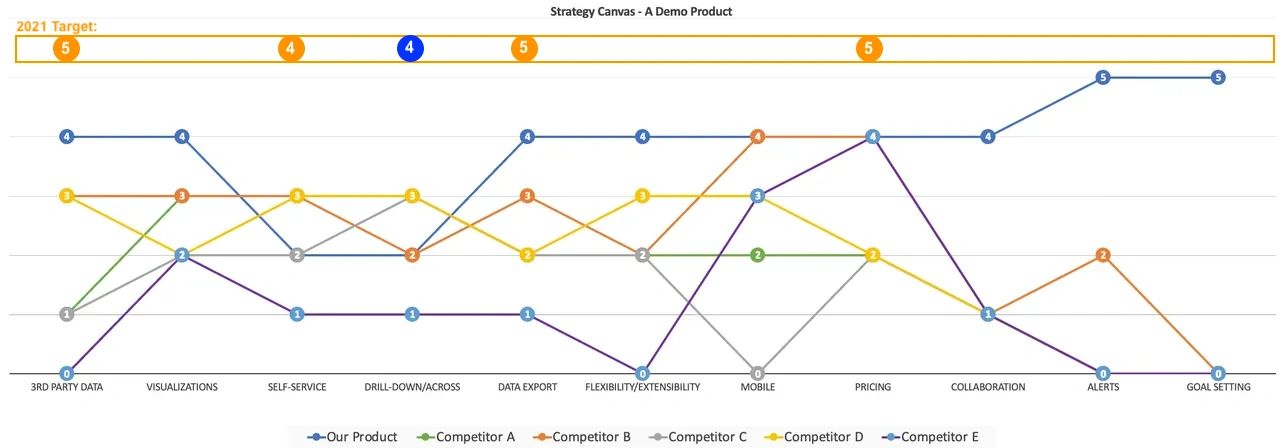
The orange circles indicate the rank that we anticipate we will be at upon completion of all the related roadmap items. (again, assuming that we deliver everything and that the competition doesn't also innovate in this same category). The blue circle indicates the rank in a category that we aspire to reach, but once we reach that rank, we do not have any current plans to go beyond it. "What the what!?!" you might be saying. But you need to consider the profile of your customers. Ask yourself, are there features and functions that your customers may never use, even if you made them available? Are there advanced capabilities only found in Enterprise level versions of your competitors products, and that 99% of your customers have no use for? Or maybe you have a set of basic functionality included with your product, but if the customer wants more advanced capabilities, they need to upgrade to a different product. There are many reasons why you might decide that a certain rank is where you are going to stop...for now. Remember, you're going to revisit the strategy canvas regularly, so it's important that you reassess these prior decisions to determine if you need to make a change in your strategy.
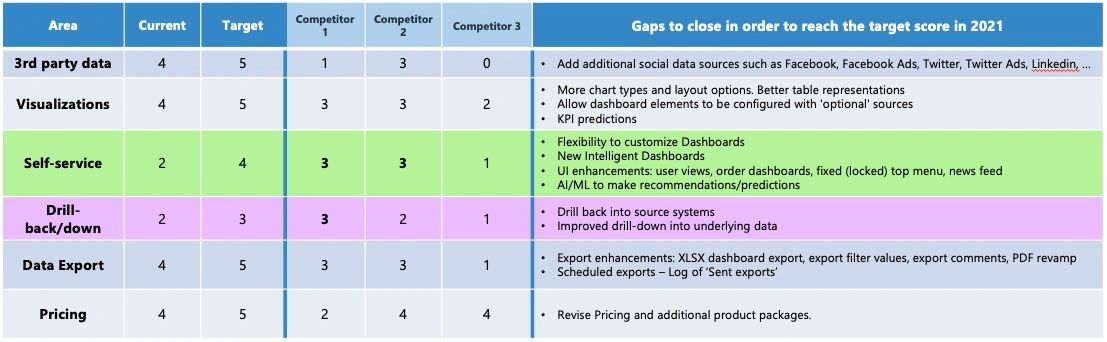
I'd also suggest that you create an additional supporting document that ties the features you have planned to each of the target ranks. This will help you answer the first question everyone will ask, "What are we doing that is going to increase our rank?". The supporting document also helps facilitate the debate that you will have with your product peers when reviewing the strategy canvas. I've provided an example of this simple, supporting document below.
Those are the basics of the strategy canvas. I'm sure that once you've added this valuable tool to your Product team's tool belt, you'll wonder how you ever managed your products without it!
Wishing you all the best
Mike
If you're interested in downloading a sample strategy canvas template that you can use in your organization, click here.
Previous
Staying Sane in an Insane World
Next
The Human Need To Reciprocate & How That Applies To Customers
Continue exploring

August 17, 2026
When Architecture Becomes Experience
One of the more interesting things I’ve noticed over the years is that software companies and customers often define the word platform very differently.
July 28, 2026
The Best Product Ideas Don’t Care Who Thought of Them
Every product leader eventually finds themselves in a familiar situation. Someone with influence has a strong opinion about what the product should do next, and the organization has to decide whether that idea represents...

July 21, 2026
When a Suite Becomes a Platform
Spend enough time in enterprise software and you’ll eventually notice that certain words begin to lose their meaning. "Innovation" is one of them. "Transformation" is another. Lately, I think "platform" belongs on that l...